
What Is Chromatography?
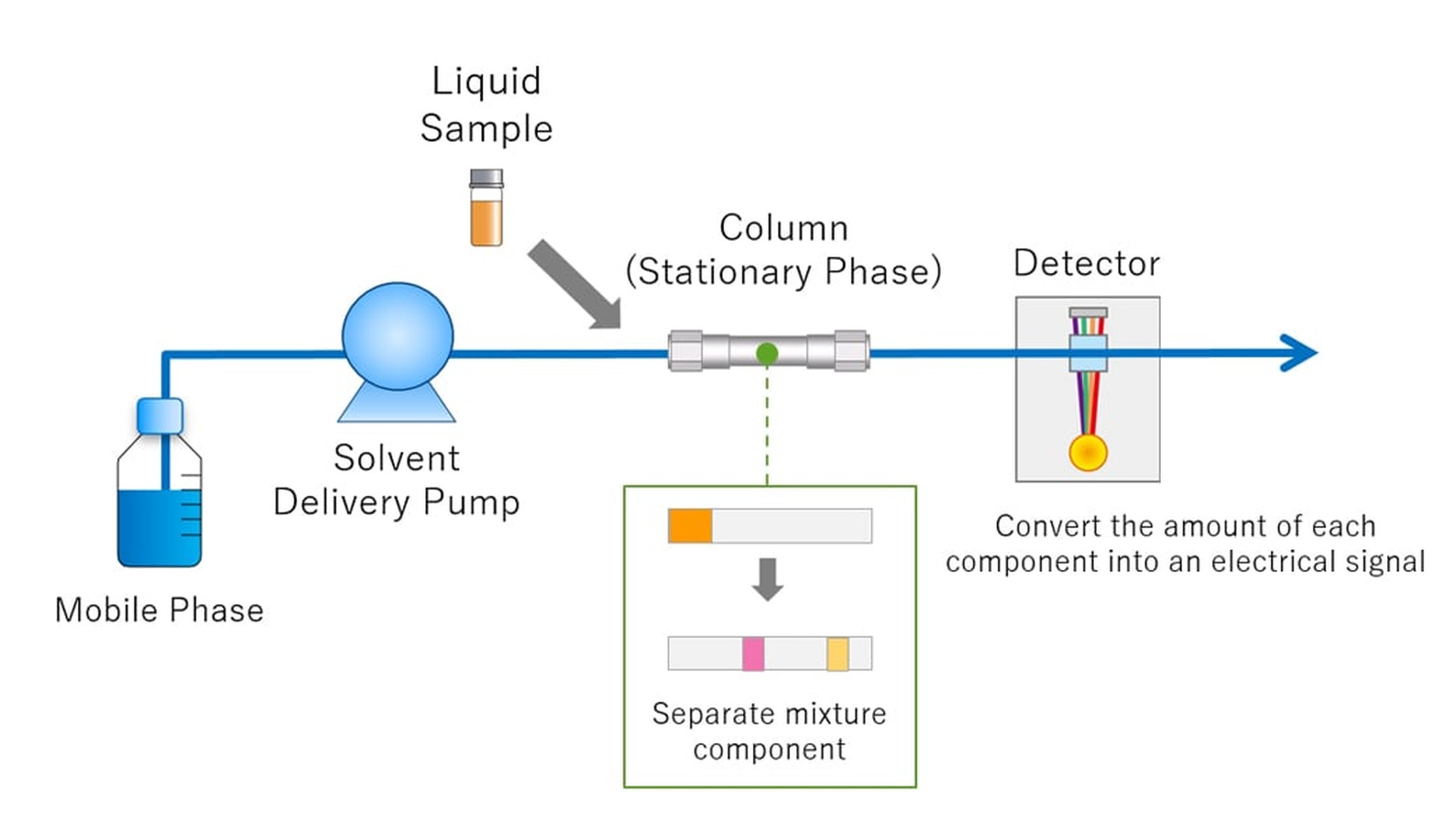
A method for separating mixtures into their components is becoming increasingly popular across many fields of science and industry, and it is called chromatography. It was first used in 1900, and over more than a century it has undergone many changes. Today there are specialized instruments that make analyses faster and detect a larger number of components. The operating principle of a chromatograph is fairly complex, but the results are more informative than they were a hundred or even 20 years ago.
How Chromatography Works
The analysis is based on the ability of substances to distribute differently between immiscible phases. During the procedure, the mixture passes through a “mobile” and a “stationary” phase. The mobile phase (the eluent) is a liquid or a gas; the stationary phase is a liquid or a solid.
How is chromatography performed? The sample under study is placed on a plate, in a tube or in a capillary and passed through the two phases. The components of the sample are retained in specific zones, and the instrument measures their amounts where required. Chromatographic methods can be qualitative (what is present) or quantitative (how much), so it is not always possible or necessary to measure the exact quantitative composition of a material.
Types of Chromatographic Analysis
The basic idea of what chromatography is and how it is performed is now clear. However, the analysis can be carried out using different methods, depending on which components of a substance need to be detected. That is why there are different types of chromatographs:
Gas chromatographs. They are used to analyze soils, liquids and industrial substances and to separate gases into individual components.
Liquid chromatographs. This type of instrument is effective for separating drugs, proteins, hormones and polymers into their components. Only a small amount of material is needed for analysis.
Chromatographic analysis also varies with the nature of the separation process. The best-known classification includes five methods, based on how the components of the mixture interact with the eluent:
Adsorption. The method is based on the different degrees to which the various components of a substance are sorbed onto a particular sorbent.
Partition. Separation occurs because complex components have different solubilities in the two phases.
Size exclusion. Separation relies on the different ability of the component molecules to penetrate the stationary phase.
Ion exchange. Because ion-exchange equilibrium constants differ, the components of a sample can be identified.
Precipitation. The precipitate of the mixture consists of different fractions that distribute differently in the solid part of the stationary phase.
It is hard to say which type of chromatography is the most widespread or the most promising, since each has its own advantages and purpose. Everything depends on the field of application and the type of samples being analyzed.
Applications of Chromatography in Medicine and Industry
Chromatographic analysis is performed to identify the components of a substance. This information is in demand in many fields:
Industry (separation and analysis of gases, liquids and solid particles).
Raw material quality control (determining the percentage composition of components and comparing the data with specifications).
Medicine (analyzing the composition of blood and other body fluids).
Pharmaceuticals (developing and testing medicines).
Chemical manufacturing (development of reagents, quality assessment, removal of impurities from substances).
High sensitivity and specificity allow chromatographs to be used in a wide range of fields. Analyses can take a long time, but some instruments are capable of rapid testing. Chromatography is a fairly expensive and labor-intensive method, but the informative results justify the costs.
Chromatography and Mass Spectrometry: Hyphenated Techniques
Modern analytical laboratories increasingly combine chromatography with mass spectrometry (GC-MS or LC-MS). Gas or liquid chromatography separates a complex mixture into individual components, while a mass spectrometer determines the molecular mass and structure of each compound. This tandem provides the highest accuracy of identification, even for trace amounts of substances.
Combined GC-MS and LC-MS systems are indispensable in clinical toxicology, doping control, environmental monitoring and pharmacokinetic studies. They can analyze dozens or even hundreds of compounds in a single sample simultaneously, which significantly shortens diagnostic time and makes results more informative.
When choosing a combined system, it is important to consider the compatibility of the chromatograph and the mass detector, the required sensitivity, the laboratory's throughput and the availability of consumables — columns, carrier gases and calibration standards.
HPLC — High-Performance Liquid Chromatography
High-performance liquid chromatography (HPLC) is one of the most widely used analytical methods in pharmaceutical and clinical practice. Unlike classical column chromatography, HPLC operates at high pressure, which makes it possible to use fine-particle sorbents and achieve exceptional separation of components.
HPLC is used for the quantitative determination of drugs and their metabolites in body fluids, quality control of finished dosage forms, and the determination of vitamins, amino acids and peptides. The method is also widely used in the food industry to detect preservatives, colorants and mycotoxins.
Modern HPLC systems are equipped with various detectors: ultraviolet (UV), diode array (DAD), fluorescence or refractive index detectors. The choice of detector depends on the physicochemical properties of the analytes and the required limit of detection.
What You Need for Chromatographic Analysis
The first step is a sample in the right form. Not all instruments can analyze liquids or solids, and sometimes the material must be prepared beforehand (diluted, mixed with a solution, frozen, ground, etc.). The chromatograph will then work more accurately and deliver reliable results.
The type of equipment depends on the analytical method, the technique and the purpose of the analysis. There are many types of chromatographs, and each organization selects the instrument that best meets its requirements. Medical and industrial equipment can be purchased from European manufacturers. They offer high-quality instruments with a long service life, suitable both for highly specialized analyses and for broad-profile work.
In addition to the chromatograph itself, a fully functioning laboratory needs consumables: chromatographic columns of various types, eluents (high-purity solvents), sample injection syringes, vials and septa, and calibration standards. Regular column replacement and timely chromatograph maintenance are key to reliable, reproducible results.
Buying a chromatograph does not have to mean spending a long time selecting a model and negotiating with manufacturers. We offer services to find suitable instruments, as well as consumables and reagents for them. KombiMED handles the entire process.
Supplying Chromatographs to Central Asia, the Caucasus and Eastern Europe
KombiMED organizes the import of chromatography equipment to Kazakhstan, Uzbekistan, Turkmenistan, Georgia, Azerbaijan, Ukraine, Moldova and EU countries. We take care of sourcing, certification checks, logistics, delivery, installation and commissioning. With our help, you can purchase a chromatograph without unnecessary complications.
Our specialists will help you choose the optimal chromatography system configuration based on your laboratory's tasks, budget and regulatory requirements. We work with leading European manufacturers of analytical equipment and offer competitive supply terms.
Frequently Asked Questions About Chromatography
How does gas chromatography differ from liquid chromatography?
Which samples can be analyzed by chromatography?
How long does a chromatographic analysis take?
How often does a chromatograph need maintenance?
Can chromatography be used in clinical diagnostics?
Related articles
Technical Process
Technical Process
Technical Process
Planning a purchase in this area?
Tell us what your laboratory needs and we will send you a tailored offer.
Contact KombiMED