
Immunoturbidimetry and Nephelometry: Protein Analysis
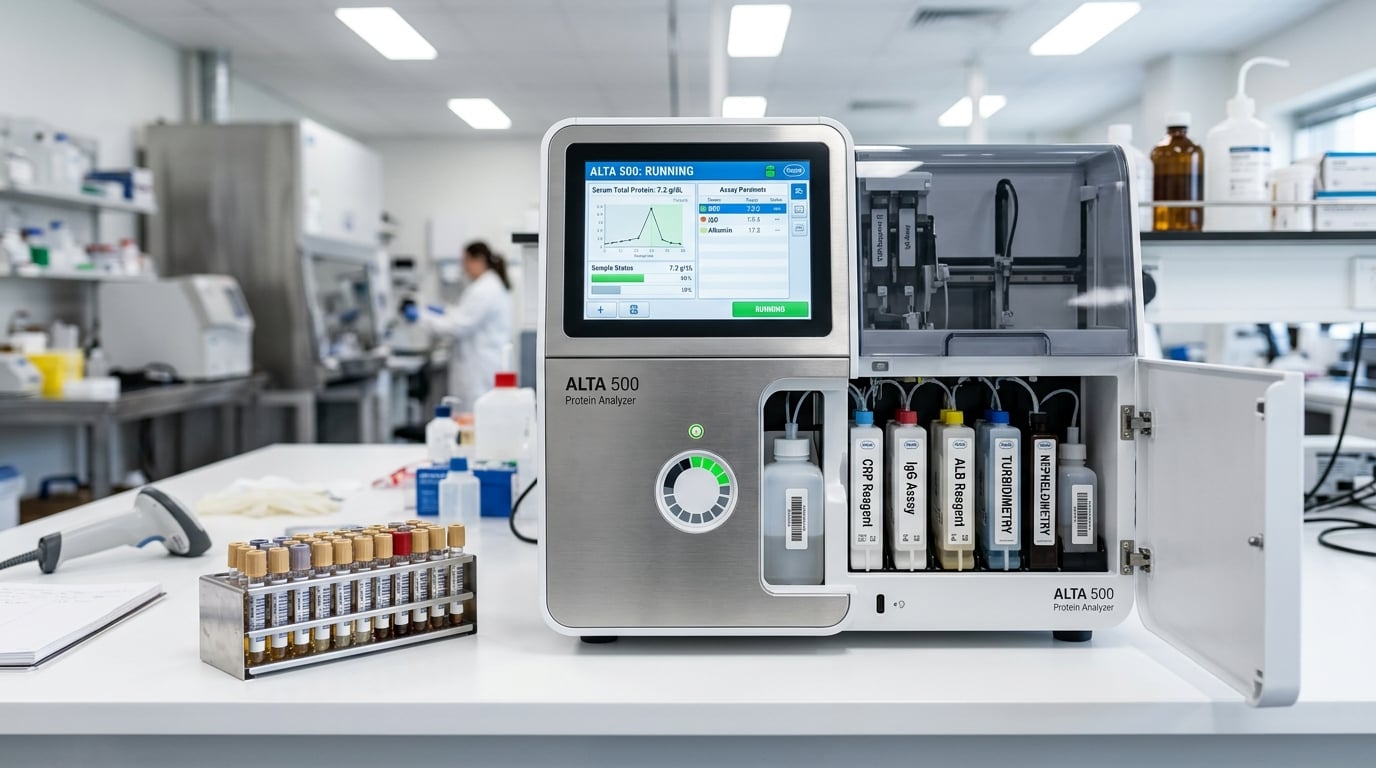
Immunoturbidimetry and nephelometry are two related methods for measuring specific proteins, based on the antigen-antibody reaction and subsequent measurement of light scattering by the resulting immune complexes. Both methods are widely used to quantify plasma proteins: CRP, immunoglobulins, complement components, and specific transport and acute-phase proteins.
How the Methods Differ
Both methods detect the interaction of light with immune complexes, but they measure different optical signals.
| Parameter | Immunoturbidimetry | Nephelometry |
|---|---|---|
| What is measured | Attenuation of transmitted light | Light scattered at an angle |
| Detection angle | 0° (in line with the beam) | usually 90° or another angle |
| Equipment | Standard clinical chemistry analyzer | Dedicated nephelometer |
| Sensitivity | Lower | Higher at low concentrations |
| Integration | Easily added to the clinical chemistry workflow | Standalone instrument |
Proteins Measured
- Acute-phase proteins: CRP (including hs-CRP), haptoglobin, ceruloplasmin
- Immunoglobulins: IgG, IgA, IgM, free light chains
- Complement components: C3, C4
- Transport proteins: transferrin, prealbumin
- Specific markers: cystatin C, microalbumin, rheumatoid factor
Practical Considerations
To extend the measuring range, latex particle-enhanced reactions are used (latex-enhanced turbidimetry), which increases sensitivity at low concentrations. It is important to account for the prozone effect (antigen excess), in which the signal paradoxically decreases at very high analyte concentrations; modern analyzers monitor for this phenomenon automatically.
Frequently Asked Questions
Which is more sensitive, turbidimetry or nephelometry?
What is the prozone effect?
Why are latex particles used?
Choosing a Specific Protein Analyzer
KombiMED GmbH is an independent procurement and market access partner for laboratory equipment from Europe. We will help you select a nephelometer or a clinical chemistry analyzer with turbidimetry to suit your laboratory's needs, and we provide delivery, installation and commissioning, and staff training.
See also:
- Analytical methods in clinical chemistry: an overview
- UV-Vis spectrophotometers
- Coagulometry and hemostasis testing
- Contact KombiMED for help selecting equipment
Related articles
Planning a purchase in this area?
Tell us what your laboratory needs and we will send you a tailored offer.
Contact KombiMED