
Analytical Methods in Clinical Chemistry: A Complete Overview
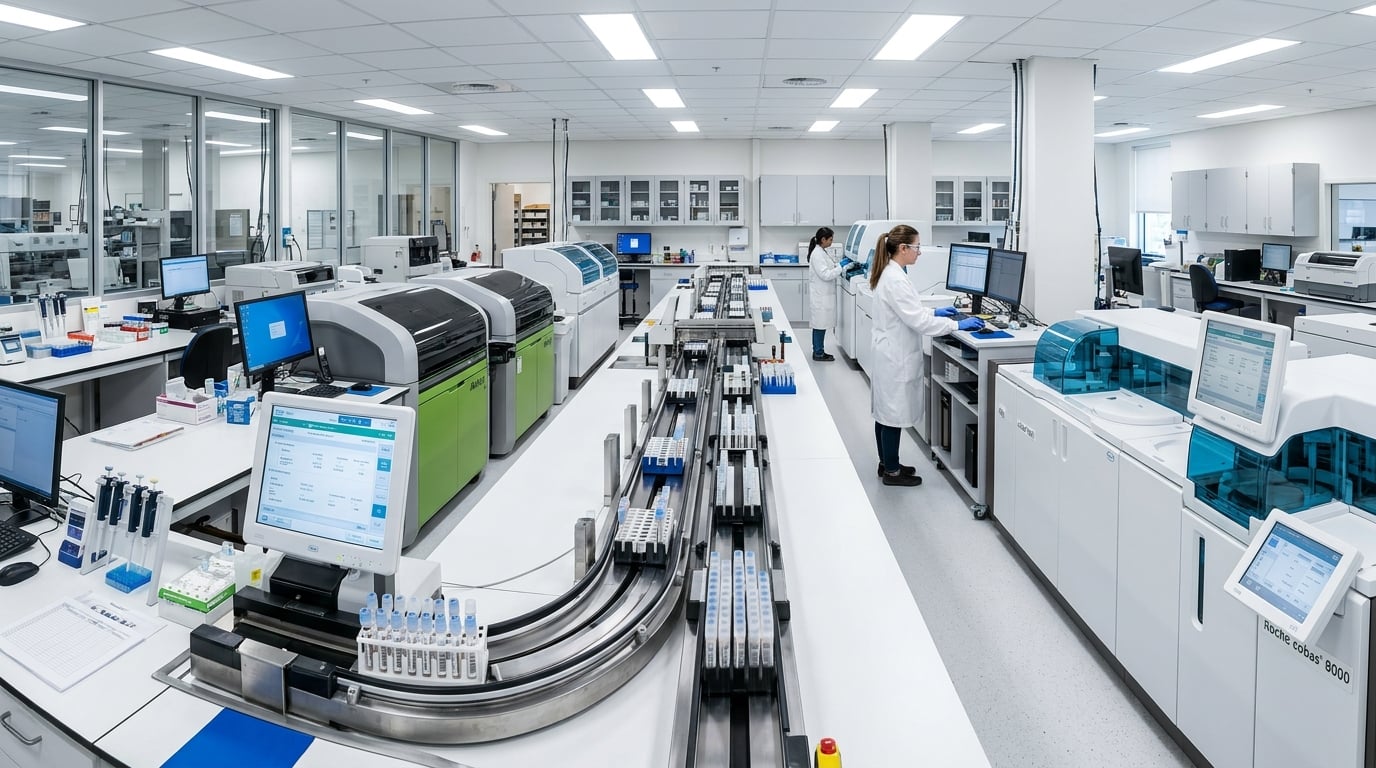
Clinical chemistry brings together dozens of analytical methods, each responsible for its own class of biomarkers — from electrolytes and proteins to hormones, drugs and trace elements. Understanding which method underlies a particular test helps you equip the laboratory properly, choose the right equipment and ensure reliable results. In this overview, we examine 12 key analytical technologies of modern clinical chemistry and link to detailed articles on each method.
12 Analytical Methods in Clinical Chemistry
| Method | What it measures | Typical analytes |
|---|---|---|
| HPLC | Separation of non-volatile compounds | Vitamins, drugs, HbA1c |
| LC-MS/MS | Highly sensitive quantification | Steroids, metabolites, TDM |
| GC / GC-MS | Analysis of volatile compounds | Toxicology, fatty acids |
| UV-Vis photometry | Light absorption | Substrates, enzymes |
| Flow cytometry | Single-cell analysis | Immunophenotyping, CD markers |
| Coagulometry | Hemostasis parameters | PT, aPTT, fibrinogen |
| Immunoturbidimetry | Light scattering in solution | CRP, specific proteins |
| Nephelometry | Light scattered at an angle | Immunoglobulins, complement |
| Electrochemistry / ISE | Electrode potential/current | Electrolytes, blood gases |
| Ligand-binding assays (ELISA/CLIA) | Antigen-antibody reaction | Hormones, markers, infections |
| AAS | Atomic absorption | Heavy metals, trace elements |
| ICP-MS | Inductively coupled plasma mass spectrometry | Multi-element trace analysis |
Below is a brief description of each group of methods, with links to detailed articles.
Chromatography: HPLC, LC-MS/MS, GC-MS
Chromatographic methods separate complex mixtures into individual components. HPLC is indispensable for non-volatile compounds (vitamins, HbA1c, drugs), GC-MS for volatile substances in toxicology, and LC-MS/MS has become the gold standard for quantifying steroids and metabolites and for therapeutic drug monitoring (TDM) thanks to its combination of selectivity and sensitivity.
Learn more: What Is Chromatography? and Mass Spectrometry: How It Works.
Spectrophotometry and Elemental Analysis: UV-Vis, AAS, ICP-MS
UV-Vis photometry is the foundation of routine clinical chemistry: light absorption measurement underlies most enzyme and substrate assays. AAS and ICP-MS handle the determination of metals and trace elements: atomic absorption is suited to individual elements, while inductively coupled plasma mass spectrometry provides multi-element analysis at trace concentrations.
Learn more: UV-Vis spectrophotometers and ICP-MS: trace element analysis.
Immunology and Cell Analysis
Flow cytometry analyzes cells one at a time, determining their size, granularity and surface markers — the basis of immunophenotyping. Ligand-binding assays (ELISA/CLIA) use the antigen-antibody reaction to quantify hormones, tumor markers and infectious disease markers. Immunoturbidimetry and nephelometry measure light scattering by antigen-antibody complexes to determine specific proteins.
Learn more: Flow Cytometry in Clinical Diagnostics, Immunoassays: ELISA, CLIA and ligand-binding methods and Immunoturbidimetry and Nephelometry.
Hemostasis and Electrochemistry
Coagulometry measures blood clotting parameters (PT, aPTT, fibrinogen) using optical and mechanical methods. Electrochemical methods and ion-selective electrodes (ISE) determine electrolytes and blood gases from changes in electrode potential or current — the standard for potassium, sodium, chloride and acid-base status analysis.
Learn more: Coagulometry and Hemostasis Testing and Electrochemical Methods and Ion-Selective Electrodes.
Frequently Asked Questions
How many methods are used in clinical chemistry?
Which method is the most sensitive?
How do I choose equipment for the methods I need?
Equipping a Clinical Chemistry Laboratory
KombiMED GmbH is an independent procurement and market access partner for laboratory equipment from Europe. We help select analyzers and instruments for the full range of clinical chemistry methods and provide delivery, commissioning and staff training in Central Asia, the Caucasus, Eastern Europe, the Baltics, the Middle East and North Africa.
See also:
- Laboratory diagnostics — services
- Flow cytometers — catalog
- Emission spectrometers (ICP) — catalog
- Contact us — equipment selection
Related articles
Planning a purchase in this area?
Tell us what your laboratory needs and we will send you a tailored offer.
Contact KombiMED