
Coagulometry and Hemostasis Testing
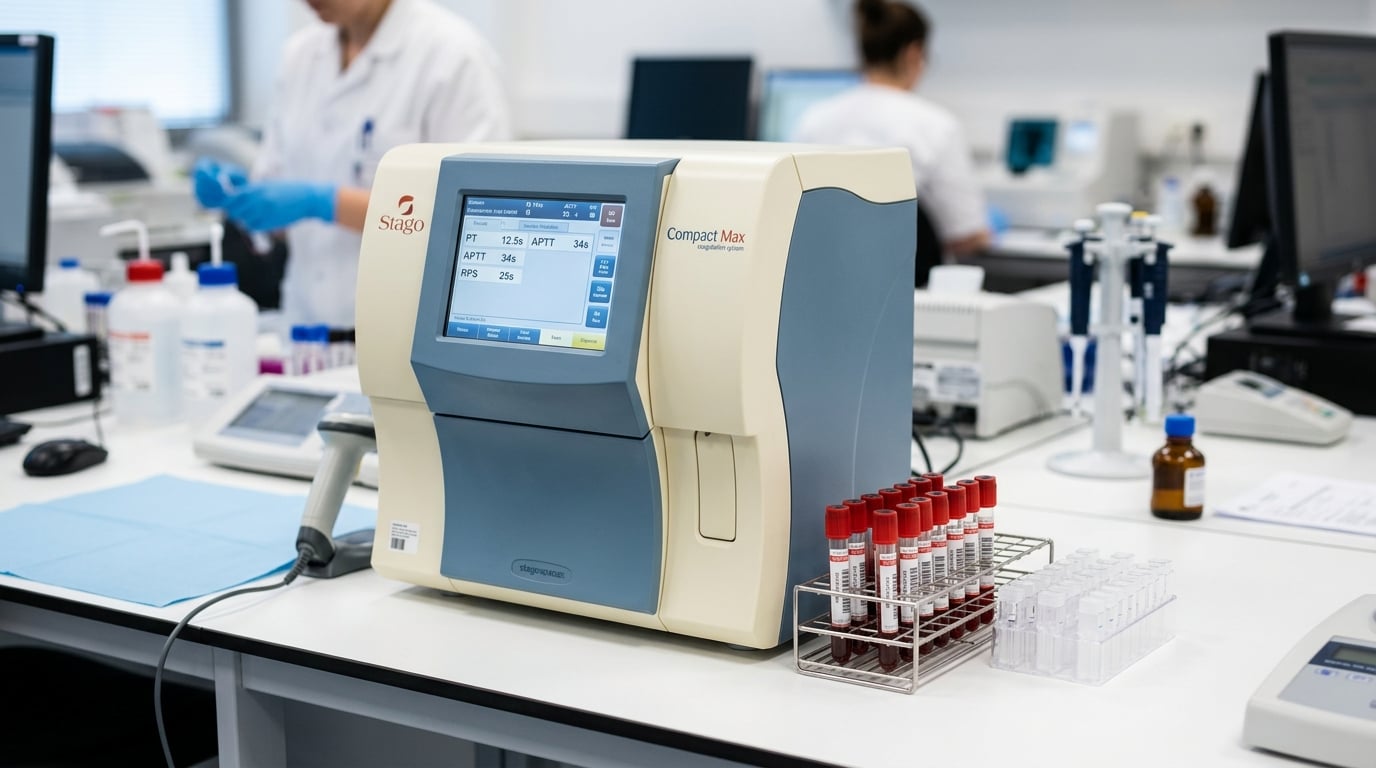
Coagulometry is a branch of laboratory diagnostics that studies the blood clotting system (hemostasis). Coagulation analyzers measure clot formation time and the activity of clotting factors, which is critical for diagnosing hemostatic disorders, monitoring anticoagulant therapy and preoperative assessment.
Clot Detection Methods
Modern coagulation analyzers use several principles to detect the moment a fibrin clot forms.
| Method | Principle |
|---|---|
| Optical (turbidimetric) | Detects the change in light transmission as the clot forms |
| Mechanical | Measures viscosity via changes in the movement of a steel ball or in oscillation |
| Chromogenic | Measures the colored product of an enzymatic reaction |
| Immunoturbidimetric | Quantifies specific hemostasis proteins |
Key Hemostasis Parameters
- PT (prothrombin time) / INR: assesses the extrinsic pathway; used to monitor warfarin
- aPTT: assesses the intrinsic pathway; used to monitor heparin therapy
- Fibrinogen: concentration of this key clotting protein
- Thrombin time: the final stage of coagulation
- D-dimer: a marker of thrombus formation and fibrinolysis
- Individual factor activity: diagnosis of hemophilias and factor deficiencies
Clinical Significance
Hemostasis testing is needed before surgery, in the diagnosis of thrombosis and bleeding, in pregnancy management, and for monitoring anticoagulant and antiplatelet therapy. The accuracy of coagulation tests depends directly on pre-analytics (the correct blood-to-citrate ratio) and regular quality control.
Learn more in our article on external quality assessment in coagulation.
Frequently Asked Questions
How does an optical coagulation analyzer differ from a mechanical one?
What does the INR show?
Why are pre-analytics important in coagulation testing?
Choosing a Coagulation Analyzer
KombiMED GmbH is an independent partner for procurement and market access for laboratory equipment from Europe. We will help you choose a coagulation analyzer and reagents to match your laboratory's volume and profile, and we provide delivery, installation and commissioning, and staff training.
See also:
- Analytical methods in clinical chemistry: an overview
- Immunoturbidimetry and nephelometry for protein analysis
- Laboratory diagnostics: our services
- Contact KombiMED for help selecting equipment
Related articles
Planning a purchase in this area?
Tell us what your laboratory needs and we will send you a tailored offer.
Contact KombiMED