
External Quality Assessment in Coagulation
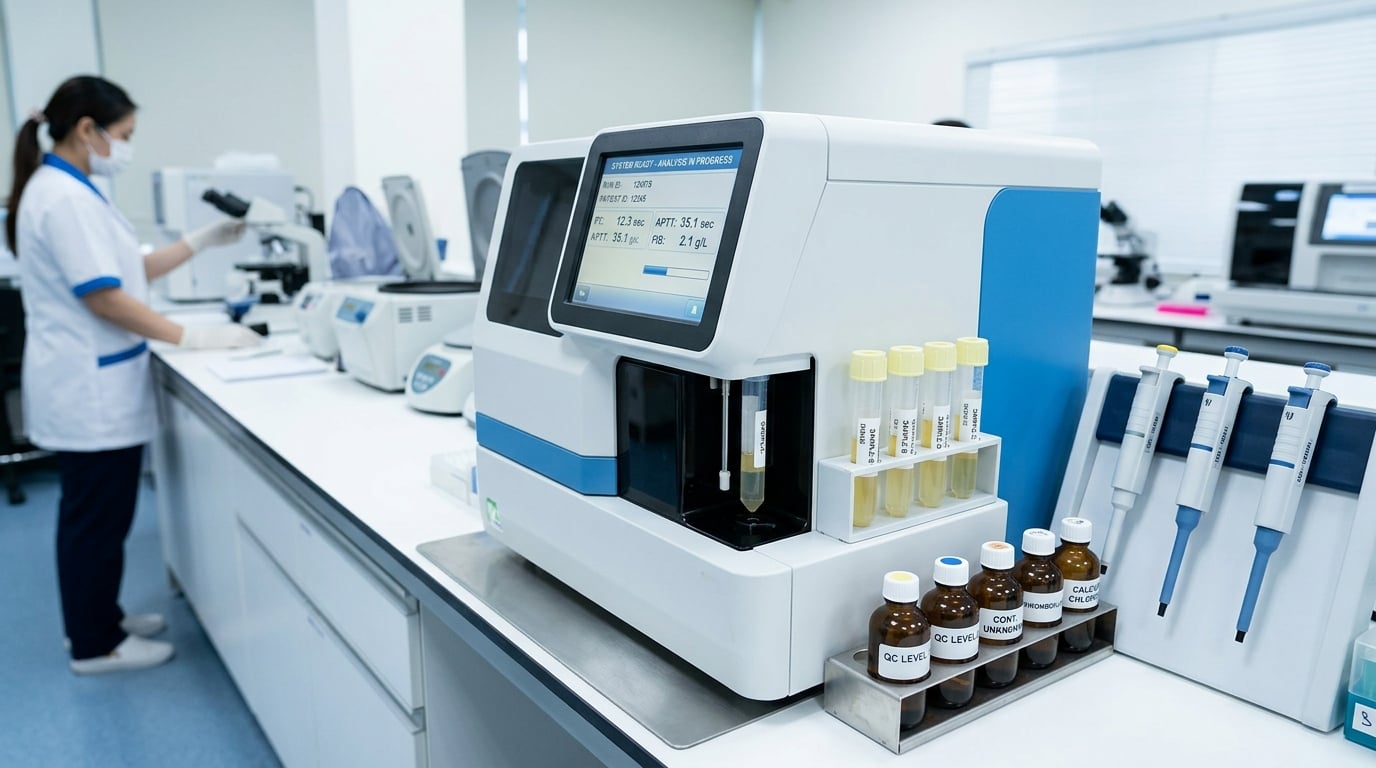
External quality assessment (EQA) in coagulation is an independent evaluation of the accuracy of blood coagulation parameters. Interlaboratory comparison (proficiency testing, PT) programs cover screening tests (PT/INR, aPTT), special tests (clotting factors, antithrombin, D-dimer) and anticoagulant therapy monitoring. The accuracy of coagulation testing has a direct impact on patient safety.
Why EQA Matters in the Hemostasis Laboratory
Hemostasis testing is an area where analytical errors have immediate clinical consequences. An incorrect INR in a patient on warfarin can lead to thrombosis or bleeding. An error in D-dimer can lead to a missed pulmonary embolism.
Specific features of coagulation EQA:
- Results are highly method-dependent: the thromboplastin, activator and instrument all affect the values
- INR standardization is critical: different ISI systems produce different INRs
- Both screening and special tests must be monitored
- Anticoagulant therapy monitoring (warfarin, heparin, DOACs) directly affects dosing
- GOST R ISO 15189-2024 requirement: EQA participation is mandatory for all coagulation tests
Parameters Covered
Screening Tests
- Prothrombin time (PT) / INR: monitoring of vitamin K antagonist therapy, screening of the extrinsic pathway
- Activated partial thromboplastin time (aPTT): screening of the intrinsic pathway, monitoring of heparin therapy
- Thrombin time (TT): assessment of the final stage of coagulation
- Fibrinogen: quantitative determination by the Clauss method
Special Tests
- Clotting factors: II, V, VII, VIII, IX, X, XI, XII, XIII
- Inhibitors: antithrombin III, protein C, protein S
- Lupus anticoagulant (LA): screening and confirmation
- Antiphospholipid antibodies: anticardiolipin (IgG, IgM), anti-β2-glycoprotein I
Markers of Thrombus Formation and Fibrinolysis
- D-dimer: exclusion of thromboembolism, monitoring of DIC
- FDP (fibrinogen/fibrin degradation products)
- Soluble fibrin monomer complexes (SFMC)
Anticoagulant Therapy Monitoring
- Anti-Xa activity: monitoring of LMWH (low-molecular-weight heparins) and DOACs (rivaroxaban, apixaban)
- Calibrated diluted thrombin time (dTT): monitoring of dabigatran
International EQA Programs
| Provider | Program | Frequency | Scope |
|---|---|---|---|
| CAP | COAG — Coagulation | 3×/year | PT/INR, aPTT, fibrinogen, factors |
| CAP | Special Coagulation | 2–3×/year | LA, antiphospholipids, inhibitors |
| Randox RIQAS | Coagulation | 12×/year | PT/INR, aPTT, D-dimer, fibrinogen |
| Bio-Rad EQAS | EQAS Coagulation | 12×/year | Full coagulation spectrum |
| INSTAND e.V. | Coagulation | 2–4×/year | PT, aPTT, factors, inhibitors |
| INSTAND e.V. | 554 Gerinnungs-Marker | 4×/year | D-dimer, FDP |
| UK NEQAS | Blood Coagulation | Up to 6×/year | Full spectrum, including LA |
| Labquality | Coagulation | 4–6×/year | Screening and special tests |
Specific Features of Coagulation EQA
The INR Standardization Problem
The INR (international normalized ratio) is a calculated value that depends on:
EQA programs for PT/INR must provide peer grouping by instrument and reagent combination; otherwise, the comparison is invalid. CAP and UK NEQAS offer the most detailed peer grouping in this area.
- The ISI (International Sensitivity Index) of the thromboplastin
- Calibration of the specific instrument with the specific reagent lot
- The end-point detection method (optical, mechanical)
Control Materials
- Lyophilized plasma: the standard format for most programs
- Liquid frozen plasma: closer to native samples, but requires a strict cold chain
- Commutability: for D-dimer and special tests, compatibility of the control matrix with the method is critical
Equipment Compatibility
Coagulation analyzers from leading manufacturers are compatible with the main EQA programs:
| Equipment type | Example models | Recommended EQA programs |
|---|---|---|
| Automated coagulation analyzers | Sysmex CS-5100, Stago STA-R Max, IL ACL TOP | CAP COAG, RIQAS, Bio-Rad, UK NEQAS |
| Semi-automated coagulation analyzers | Tcoag Cascade, Amelung KC | CAP COAG, INSTAND, Labquality |
| POCT coagulation analyzers | Roche CoaguChek, Abbott i-STAT | CAP POCT, RIQAS, INSTAND |
Criteria for Choosing an EQA Program
1. Peer grouping by instrument and reagent system: mandatory for PT/INR
2. Coverage of special tests: LA, factors, inhibitors, anti-Xa
3. Round frequency: monthly monitoring (RIQAS, Bio-Rad) for screening tests
4. Clinically meaningful evaluation: the program should assess not only analytical accuracy but also clinical acceptability (for INR, whether the result falls within the therapeutic range)
5. Support for DOAC monitoring: programs for anti-Xa and dTT are increasingly in demand
6. Sample logistics: lyophilized panels are preferable for laboratories in the CIS region
Practical Recommendations
Optimal Strategy
- Basic set: CAP COAG + Randox RIQAS for international accreditation plus monthly monitoring
- Extended set: add UK NEQAS Blood Coagulation for special tests (LA, factors)
- POCT: separate programs for portable coagulation analyzers (CAP POCT, INSTAND)
Working with Results
- Analyze INR results in the context of your own instrument and reagent peer group
- For D-dimer, take into account differences in units of measurement (FEU vs DDU) and methods
- If aPTT shows a systematic deviation, check the reagent lot and the activator
Documentation
- Keep a separate EQA log for coagulation testing
- Record corrective actions linked to the specific analyte and round
- Make EQA reports available to auditors, as required by ISO 15189
KombiMED's Comprehensive Approach
KombiMED supplies coagulation equipment for laboratories of any size, from semi-automated coagulation analyzers to high-throughput systems. We help laboratories enroll in international EQA programs that match the reagent systems they use.
Our specialists can help you:
Request a consultation on external quality assessment programs for your hemostasis laboratory.
- Select EQA programs for screening and special coagulation tests
- Ensure correct peer grouping for INR monitoring
- Prepare your hemostasis laboratory for accreditation to GOST R ISO 15189-2024
Related articles
Quality Control
Quality Control
Planning a purchase in this area?
Tell us what your laboratory needs and we will send you a tailored offer.
Contact KombiMED