
Integrating and Digitalizing External Quality Assessment
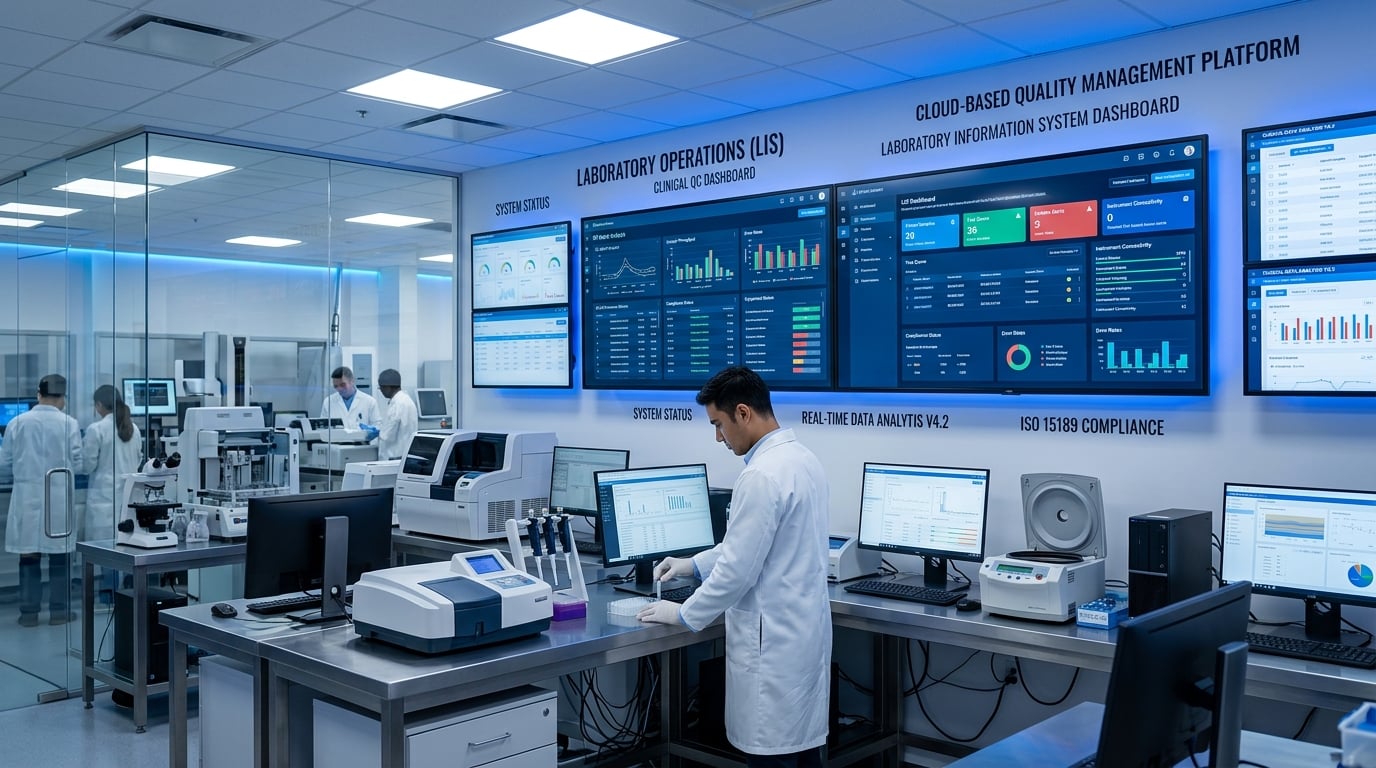
Integrating external quality assessment (EQA) programs into a single digital management system is the next step in the evolution of laboratory quality management. Modern platforms make it possible to automate result entry, run real-time benchmarking and build an audit trail for accreditation under GOST R ISO 15189-2024.
From Manual Control to a Digital Ecosystem
The traditional approach to EQA means working with many disconnected providers: separate portals for entering results, paper reports, manual analysis of deviations and scattered documentation. For a multidisciplinary laboratory taking part in 10–15 EQA programs from 5–7 providers, this creates a significant administrative burden.
Problems with manual EQA management:
Digitalization solves these problems by shifting EQA management from reactive to proactive.
- Risk of errors when results are entered manually into provider portals
- No unified picture of quality across all areas of the laboratory
- No way to quickly analyze trends and round-to-round dynamics
- Difficult audit preparation, with reports collected from different sources
- Time lost on routine tasks instead of root-cause analysis and corrective actions
Architecture of an Integrated EQA System
Level 1: Analytical Equipment
Modern analyzers generate quality control data automatically. Key interfaces:
- HL7 / ASTM: standard protocols for transmitting laboratory data
- Middleware: intermediate software that validates results before they are sent to the LIS
- Built-in QC: the analyzers' automatic quality control modules
Level 2: Laboratory Information System (LIS)
The LIS serves as the central hub for all quality data:
- Registration of EQA rounds and control materials
- Automatic linking of results to a specific instrument, operator and reagent lot
- Storage of Levey-Jennings charts and Westgard rules for internal QC
- Report generation for auditors
Level 3: EQA Provider Platforms
Leading providers offer digital platforms with advanced analytics:
| Platform | Provider | Functionality |
|---|---|---|
| Unity Real-Time | Bio-Rad | LIS integration, peer comparisons, automatic SDI/CVR calculation |
| RIQAS 24/7 | Randox | Online portal, peer grouping, instant reports |
| CAP e-LAB Solutions | CAP | Electronic result entry, analytical tools |
| QCBOX | Various | Multi-provider platform, benchmarking |
| iLab / LabLink xL | Various | End-to-end QC automation, IQC and EQA integration |
Level 4: Quality Dashboard
A single dashboard that brings together data from all sources:
- Status of all EQA programs in one interface
- Visualization of z-scores and SDI across all areas
- Automatic alerts when deviations occur
- Tracking of corrective and preventive actions (CAPA)
- Ready-made reports for internal and external audits
Measurable Results of Digitalization
Implementing integrated quality management systems delivers concrete improvements:
| Indicator | Before digitalization | After digitalization |
|---|---|---|
| Internal QC implementation rate | 97.8% | 99.9% |
| Reporting error rate | 0.048% | 0.027% |
| Unacceptable EQA results (annual) | 2–5% | Approaching 0% |
| Audit preparation time | 2–3 weeks | 1–2 days |
| Time from receipt of EQA result to analysis | 5–10 days | Real time |
Building an EQA Program Portfolio
Selection Principles
For a multidisciplinary laboratory, the optimal EQA portfolio follows a "core + specialization" principle:
Basic level (mandatory minimum):
Extended level:
High-tech laboratories:
- CAP: international accreditation, broad coverage
- Randox RIQAS: monthly monitoring, fast feedback
- INSTAND e.V.: the standard for the German-speaking market and the CIS region
- Bio-Rad EQAS: integration via Unity Real-Time
- Labquality: a European provider focused on ISO 15189
- UK NEQAS: specialized programs, in-depth expertise
- RfB / DGKL: clinical chemistry, hematology
- QCMD: molecular diagnostics (PCR, qPCR, NGS)
- EMQN: genetics, oncogenomics
- NordiQC: immunohistochemistry
- ESP: pathomorphology
Mapping Providers to Testing Areas
| Area | Primary provider | Additional |
|---|---|---|
| Clinical chemistry | CAP, RIQAS | Bio-Rad, INSTAND, RfB |
| Hematology | CAP, RIQAS | Bio-Rad, UK NEQAS, INSTAND |
| Coagulation | CAP, RIQAS | Bio-Rad, UK NEQAS |
| Immunochemistry | CAP, RIQAS | Bio-Rad, INSTAND, UK NEQAS |
| Microbiology | CAP, UK NEQAS | INSTAND, Labquality |
| Molecular diagnostics | QCMD, CAP | INSTAND, EMQN |
| IHC / Histopathology | NordiQC, CAP | UK NEQAS, ESP |
| POCT | CAP, RIQAS | INSTAND, Labquality |
| Urinalysis | CAP, RIQAS | Bio-Rad |
GOST R ISO 15189-2024 Requirements for EQA Management
The standard sets clear requirements for organizing external quality assessment:
1. Mandatory participation (clause 7.3.7.3): the laboratory must take part in EQA/PT programs for all tests it performs
2. Alternative interlaboratory comparisons: if no provider program is available, the laboratory must organize its own interlaboratory comparisons
3. Analysis of results: not just participation, but systematic analysis that identifies trends
4. Corrective actions: documented CAPA for unsatisfactory results
5. Risk-based approach: prioritization of control areas based on risk assessment
6. Inclusion of POCT: point-of-care testing is subject to the same requirements
7. Staff competence: operators must be able to interpret EQA reports
Practical Implementation Recommendations
Stage 1: Audit of the Current State
- Compile a register of all EQA programs the laboratory participates in
- Assess coverage: is every test covered by external assessment?
- Identify gaps: areas without EQA are priorities for enrollment
Stage 2: Portfolio Optimization
- Eliminate duplication: for some areas, one provider is enough
- Add missing programs, with particular attention to molecular diagnostics and POCT
- Ensure peer grouping: every analyzer should have a relevant peer group
Stage 3: Digital Integration
- Integrate provider platforms (Unity Real-Time, RIQAS 24/7) with the LIS
- Set up automatic collection of internal and external QC data into a single dashboard
- Implement a system of automatic alerts for deviations
Stage 4: Continuous Improvement
- Review EQA results across all areas every quarter
- Analyze trends: a growing bias matters more than a single outlier
- Use EQA data to plan equipment maintenance and staff training
KombiMED's Comprehensive Approach
KombiMED is a German full-cycle partner for medical laboratories. We provide complete laboratory setups, from selecting equipment from 68+ leading global brands to integrating with international external quality assessment programs. Our approach: equipment + reagents + EQA + training = a working quality system.
Our specialists can help you:
Request a consultation on the end-to-end implementation of an external quality assessment system.
- Audit your current EQA program portfolio and identify gaps
- Build the optimal set of EQA programs for your laboratory's profile
- Integrate provider platforms with your laboratory information system
- Prepare your laboratory for accreditation under GOST R ISO 15189-2024
Related articles
Quality Control
Quality Control
Quality Control
Planning a purchase in this area?
Tell us what your laboratory needs and we will send you a tailored offer.
Contact KombiMED