
External Quality Assessment in Hematology
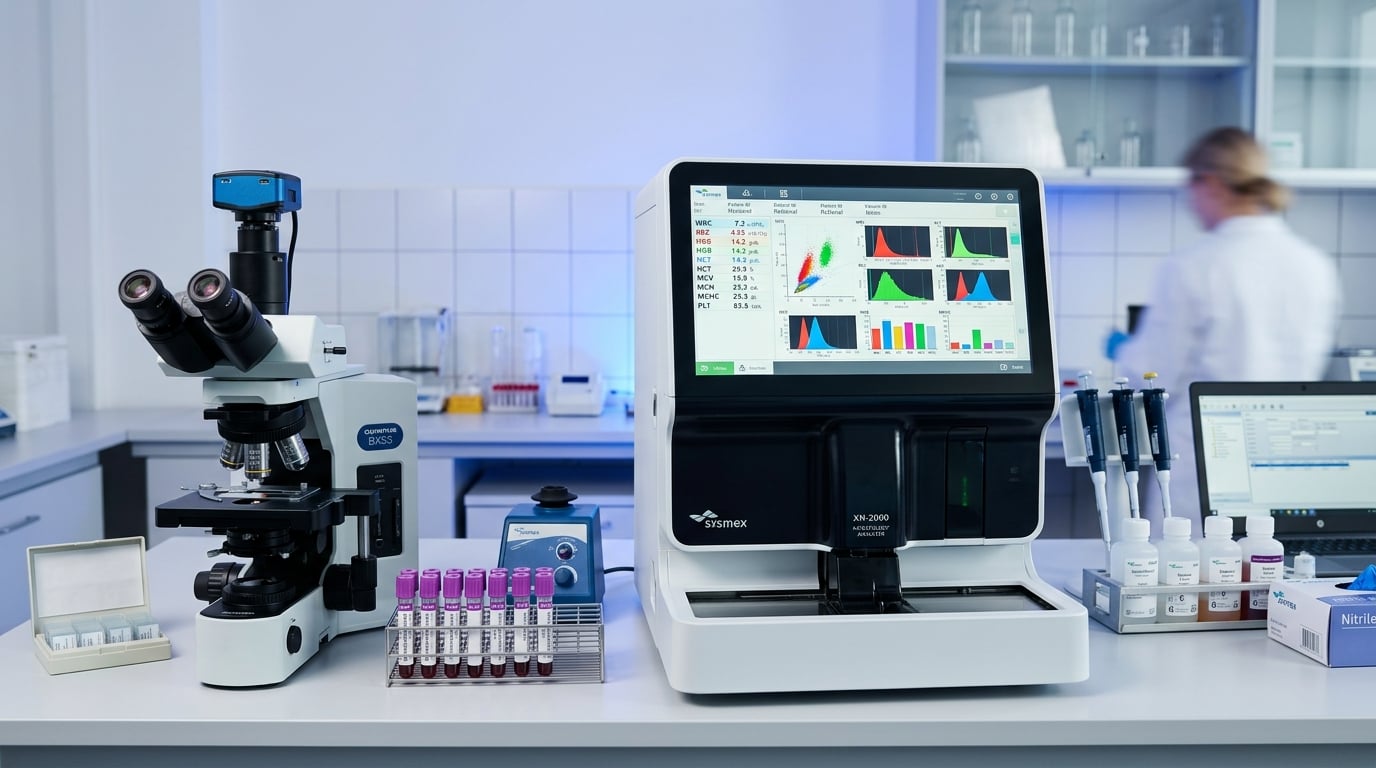
External quality assessment (EQA) in hematology is an independent evaluation of the accuracy of complete blood count results, the white blood cell differential and morphological cell differentiation through participation in interlaboratory comparison (proficiency testing, PT) programs. Participation in EQA programs is required to meet GOST R ISO 15189-2024 and for international laboratory accreditation.
The Role of EQA in Hematology Diagnostics
Hematology tests are among the highest-volume tests in the clinical laboratory. A complete blood count (CBC) with a 5- or 6-part white blood cell differential is performed on virtually every patient. Accurate cell counts and hemoglobin measurement are critical for diagnosing anemia, infections and hematologic malignancies and for monitoring therapy.
Risks without external quality assessment:
PT programs make it possible to objectively evaluate analyzer performance, operator competence and the correctness of calibration settings.
- Systematic under- or overestimation of hemoglobin: errors in diagnosing anemia
- Incorrect platelet counts: risk of an inadequate assessment of the coagulation system
- Incorrect white blood cell differential: missed blast cells, false neutropenia
- Undetected reticulocyte problems: loss of information on erythropoietic regeneration
Parameters Covered
Basic Hematology Parameters
- Red cell parameters: RBC, hemoglobin (Hb), hematocrit (Hct), MCV, MCH, MCHC, RDW
- White cell parameters: WBC, 5-diff (neutrophils, lymphocytes, monocytes, eosinophils, basophils)
- Platelet parameters: PLT, MPV, PDW, P-LCR
- Reticulocytes: RET%, RET#, IRF (immature reticulocyte fraction)
Extended Parameters
- Nucleated red blood cells (NRBC)
- Immature granulocytes (IG)
- Scattergrams and analyzer flags
- ESR (erythrocyte sedimentation rate)
Blood Morphology
- Microscopic differentiation of blood smears
- Identification of abnormal cells: blasts, atypical lymphocytes, schistocytes
- Assessment of red blood cell and platelet morphology
EQA Programs for Hematology Laboratories
| Provider | Program | Frequency | Parameter coverage |
|---|---|---|---|
| CAP | HEME, HEME2 | 3–4×/year | CBC, 5/6-Diff, reticulocytes, morphology |
| Randox RIQAS | H-General Haematology | 12×/year | CBC, 5-Diff, reticulocytes, ESR |
| Bio-Rad EQAS | EQAS Haematology | 12×/year | CBC, 5-Diff, reticulocytes |
| INSTAND e.V. | Ringversuch 330 | 4×/year | Complete blood count, morphology |
| UK NEQAS | Haematology | 6×/year | CBC, morphology, international comparisons |
| Labquality | Haematology | 4–6×/year | CBC, reticulocytes, morphology |
Specialized Programs
- UK NEQAS Morphology: expert assessment of blood smear microscopy skills
- CAP Differential: precise assessment of the white blood cell differential
- BioLab (IT): specialized panels: reticulocytes (RET), nucleated red blood cells (NRBC), autoimmune diagnostics
Compatibility with Hematology Equipment
All leading providers support peer grouping by analyzer type and method, which ensures valid interlaboratory comparisons. For Sysmex XN-series analyzers, we recommend also enrolling in programs for extended parameters (NRBC, IG, IPF).
| Analyzer | Manufacturer | Recommended EQA programs |
|---|---|---|
| XN-1000 / XN-2000 | Sysmex | CAP HEME, RIQAS, Bio-Rad EQAS, UK NEQAS |
| DxH 900 | Beckman Coulter | CAP HEME, RIQAS, Bio-Rad EQAS, INSTAND |
| BC-5310 / BC-6800 | Mindray | CAP HEME, RIQAS, Bio-Rad EQAS |
| Yumizen H2500 | Horiba | CAP HEME, RIQAS, Labquality |
| Alinity h-series | Abbott | CAP HEME, RIQAS, Bio-Rad EQAS |
Criteria for Choosing a Hematology EQA Program
1. Parameter coverage: the program should cover every test you perform, from the basic CBC to extended parameters (reticulocytes, NRBC, IG)
2. Peer group availability: comparison of results with laboratories using the same analyzer and method
3. Morphology component: separate panels to assess the competence of microscopists
4. Round frequency: monthly assessment (RIQAS, Bio-Rad) helps detect shifts promptly
5. Sample format: stabilized blood with characteristics close to native samples (commutability)
6. Digital platform: online result entry and access to real-time analytics
Interpreting Results and Corrective Actions
Performance Metrics
- z-score: acceptable range |z| ≤ 2.0. For hematology parameters, pay particular attention to systematic shifts in one direction over several rounds
- SDI: standard deviation index within the peer group. Shows how stable a specific analyzer's performance is
- Bias (%): percentage deviation from the target value. For Hb and PLT, the allowable bias is determined by clinical needs
What to Do When Results Deviate
1. Check the pre-analytical phase: storage time and conditions of control samples, temperature during transport
2. Review calibration: date of the last calibration, calibrator lot, internal QC results for the same period
3. Perform a trend analysis: is the shift increasing, or is it an isolated event?
4. Apply Westgard rules: compare EQA results with the Levey-Jennings charts from internal QC
5. Document: record the root cause analysis and corrective actions in the CAPA system
Practical Recommendations
For New Laboratories
- Start with a basic combination: CAP HEME + Randox RIQAS, which provides both international recognition and monthly monitoring
- Add a morphology program (UK NEQAS or CAP Differential) if the laboratory performs blood smear microscopy
For Laboratories in the CIS Region
- INSTAND and Labquality programs offer simpler shipping logistics than CAP kits from the USA
- RIQAS samples are stable during transport and do not require a strict cold chain for most panels
LIS Integration
- Set up automatic transfer of EQA data to the laboratory information system (LIS)
- Use the RIQAS 24/7 and Unity Real-Time platforms to archive reports in accordance with ISO 15189 §5.6
KombiMED's Comprehensive Approach
KombiMED supplies hematology analyzers from the world's leading manufacturers (Sysmex, Beckman Coulter, Mindray, Horiba, Abbott) and provides full-cycle support, from equipment selection to enrollment in international external quality assessment programs.
Our specialists can help you:
Request a consultation on external quality assessment programs for hematology testing.
- Define the optimal set of EQA programs for your analyzer configuration
- Organize the logistics of control samples with regional specifics in mind
- Prepare your laboratory for accreditation to GOST R ISO 15189-2024
Related articles
Quality Control
Quality Control
Quality Control
Planning a purchase in this area?
Tell us what your laboratory needs and we will send you a tailored offer.
Contact KombiMED