
ICP-MS: Mass Spectrometry and Trace Element Analysis
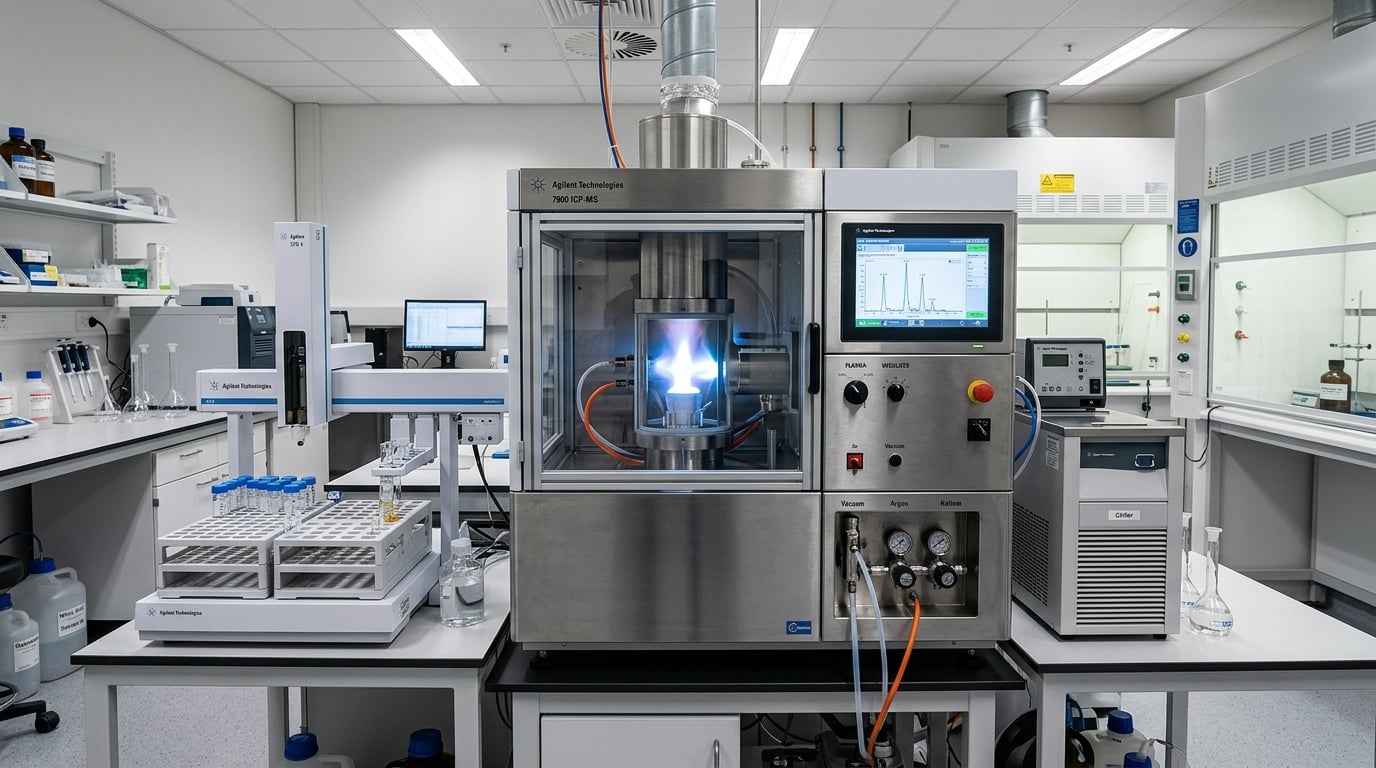
ICP-MS (inductively coupled plasma mass spectrometry) is the most sensitive method of multi-element analysis. It allows dozens of chemical elements to be determined simultaneously at trace and ultra-trace concentrations (ng/L). In clinical chemistry and toxicology, ICP-MS is used to determine heavy metals and trace elements in body fluids.
Principle of the Method
The sample is introduced into an argon plasma at a temperature of about 6000–10000 K, where the substance is atomized and ionized. The resulting ions are directed into a mass analyzer, which separates them by mass-to-charge ratio (m/z) and counts the number of each isotope.
Key instrument components:
- Sample introduction system — nebulizer and spray chamber
- Inductively coupled plasma — ionization source
- Interface and ion optics — transfer of ions into the vacuum
- Mass analyzer — quadrupole, time-of-flight or sector field
- Detector — electron multiplier
ICP-MS vs. ICP-OES: What Is the Difference?
| Parameter | ICP-MS | ICP-OES |
|---|---|---|
| What is measured | Ions by m/z | Light emission |
| Detection limits | ng/L (ppt) | µg/L (ppb) |
| Isotope analysis | Yes | No |
| Operating cost | Higher | Lower |
| Best for | Ultra-trace analysis | High concentrations |
ICP-MS is chosen when maximum sensitivity and isotope determination are needed, and ICP-OES for routine elemental analysis at higher concentrations.
Clinical and Toxicological Applications
- Toxicology — lead, mercury, cadmium and arsenic in blood and urine
- Trace elements — selenium, zinc, copper, manganese
- Monitoring — metal levels in patients with joint replacements
- Pharmacology — platinum-based drugs
- Environment and food safety — contamination control
To eliminate polyatomic interferences, modern instruments use collision/reaction cells (KED, DRC), which improves the reliability of results in complex biological matrices.
Frequently Asked Questions
How does ICP-MS differ from AAS?
What is a collision cell?
When should you choose ICP-OES instead of ICP-MS?
Selecting an ICP-MS System or Elemental Analyzer
KombiMED GmbH is an independent procurement and market access partner for laboratory equipment from Europe. We will help you select an ICP-MS or ICP-OES system for your laboratory's needs and provide delivery, commissioning and staff training in Central Asia, the Caucasus, Eastern Europe, the Baltics, the Middle East and North Africa.
See also:
- Analytical Methods in Clinical Chemistry — overview
- Mass Spectrometry: How It Works
- Electrochemical Methods and Ion-Selective Electrodes
- Emission spectrometers (ICP) — catalog
- Contact KombiMED — equipment selection
Related articles
Planning a purchase in this area?
Tell us what your laboratory needs and we will send you a tailored offer.
Contact KombiMED