
Telepathology: Remote Diagnostics Without Borders
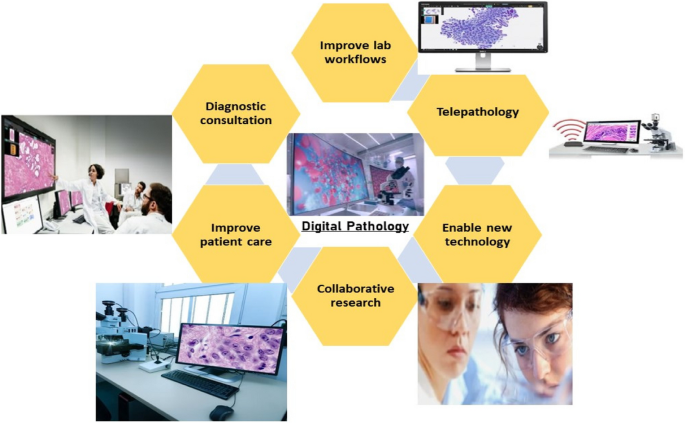
Telepathology removes geographic barriers: a pathologist anywhere in the world can view, annotate and sign out digital slides. This is critical for regions with a shortage of specialists, for urgent intraoperative consultations and for international expert opinions. KombiMED implements telepathology solutions for clinics and laboratory networks.
What Is Telepathology?
Telepathology is the use of telecommunication technologies to transmit pathology images for remote diagnosis, consultation and education. Depending on the transmission method, there are three main types:
Static Telepathology (Store-and-Forward)
The referring pathologist photographs key fields of view and sends them to an expert. The method is simple and places few demands on the network connection, but it is limited by the selective nature of the images.
Dynamic Telepathology (Real-Time)
The remote expert controls a motorized microscope or views a live video stream from a camera in real time. This allows full navigation across the specimen but requires a stable connection.
WSI-Based Telepathology (Whole Slide Imaging)
This is the most advanced and promising method. The entire slide is scanned, and the digital slide becomes available through a web interface. The expert works with the full-resolution image just as at a microscope, but remotely.
Clinical Use Cases
Urgent Intraoperative Consultations (Frozen Section)
During surgery, the surgeon sends a frozen section for rapid diagnosis. If no pathologist is on site, the digital slide is transmitted to a remote expert. The turnaround time is 10–15 minutes, comparable to a conventional frozen section.
Expert Second Opinion
Complex and borderline cases, such as soft tissue tumors, rare lymphomas and neuropathology, are referred to subspecialists at leading centers without physically shipping glass slides.
Centralized Diagnostics in Laboratory Networks
Large laboratory networks connect remote specimen collection sites with a central laboratory. Local scanners create WSIs that are routed to pathologists at the central office.
Multidisciplinary Tumor Boards
Digital slides are shown simultaneously to several members of the tumor board (pathologist, oncologist, surgeon, radiologist) via a web conference with synchronized navigation.
Education and Certification
Digital slides are used for remote training of residents, for examinations and for international continuing education programs.
Technical Requirements
Scanning Infrastructure
- High-speed WSI scanners with continuous loading
- Automatic focusing and scan quality control
- Supported formats: SVS, NDPI, MRXS, iSyntax, DICOM WSI
Network and Data Storage
- Bandwidth: at least 100 Mbps for comfortable work with WSIs
- Size of a single WSI: 500 MB – 3 GB (at 40× scanning)
- Cloud or hybrid storage with a CDN for faster delivery
- Encryption of data at rest and in transit (TLS 1.3, AES-256)
Software Platform
Example: PathoZoom® Digital Lab provides full telepathology functionality: a web viewer, collaboration, case management, and integration with the LIS/HIS via HL7/FHIR.
- Web viewer supporting gigapixel images without installing client software
- Tools for annotation, measurement and slide comparison
- Synchronized navigation for multiple users
- LIS integration: automatic linking of slides to the case
Benefits of Telepathology
Subspecialists are accessible from anywhere, which is critical for regions with a shortage of pathologists.
Frozen section consultations are performed without delay: the surgeon does not have to wait for a pathologist to arrive.
Glass slides no longer need to be shipped physically, saving time and courier costs.
An expert second opinion reduces the rate of diagnostic errors by 5–10%.
Vacations, sick leave, night shifts: remote pathologists provide uninterrupted coverage.
Digital archives of complex cases build a knowledge base for training.
- Access to expertise
- Faster intraoperative diagnosis
- Lower logistics costs
- Better diagnostic quality
- Laboratory business continuity
- Educational value
Regulatory Aspects
WSI-based telepathology requires compliance with:
For cross-border consultations, data localization requirements must be taken into account: some jurisdictions prohibit storing citizens' medical data outside the country. Hybrid architectures with local storage and cloud-based viewing solve this problem.
- CE-IVD: certification of scanners and viewers as medical devices
- ISO 13485: quality management system for medical devices
- GDPR / HIPAA: protection of personal health data during cross-border transfer
- IHE Anatomic Pathology Workflow: the interoperability standard for pathology systems
Cost-Effectiveness
Telepathology delivers a compelling economic return:
- Lower logistics costs: glass slides no longer need to be shipped between institutions, saving up to $15–30 per case
- Optimized staffing: one expert pathologist can serve several institutions remotely
- Less downtime: the operating room does not wait for a pathologist to arrive for a frozen section
- Access to subspecialists: world-class consultations are available without travel expenses
KombiMED Solutions
KombiMED implements end-to-end telepathology solutions:
Request a consultation: we will design a telepathology solution tailored to your institution's infrastructure and needs.
*KombiMED: centralized procurement of medical equipment from Europe.*
- Design of telepathology networks for clinics and laboratory networks
- Supply of scanners and server hardware
- Platform deployment: PathoZoom® Digital Lab, cloud and hybrid configurations
- Information security and regulatory compliance
- Staff training and 24/7 technical support
Related articles
AI & Software
AI & Software
Planning a purchase in this area?
Tell us what your laboratory needs and we will send you a tailored offer.
Contact KombiMED