
ISO 15189, CAP or CLIA: Does Accreditation Improve QC?
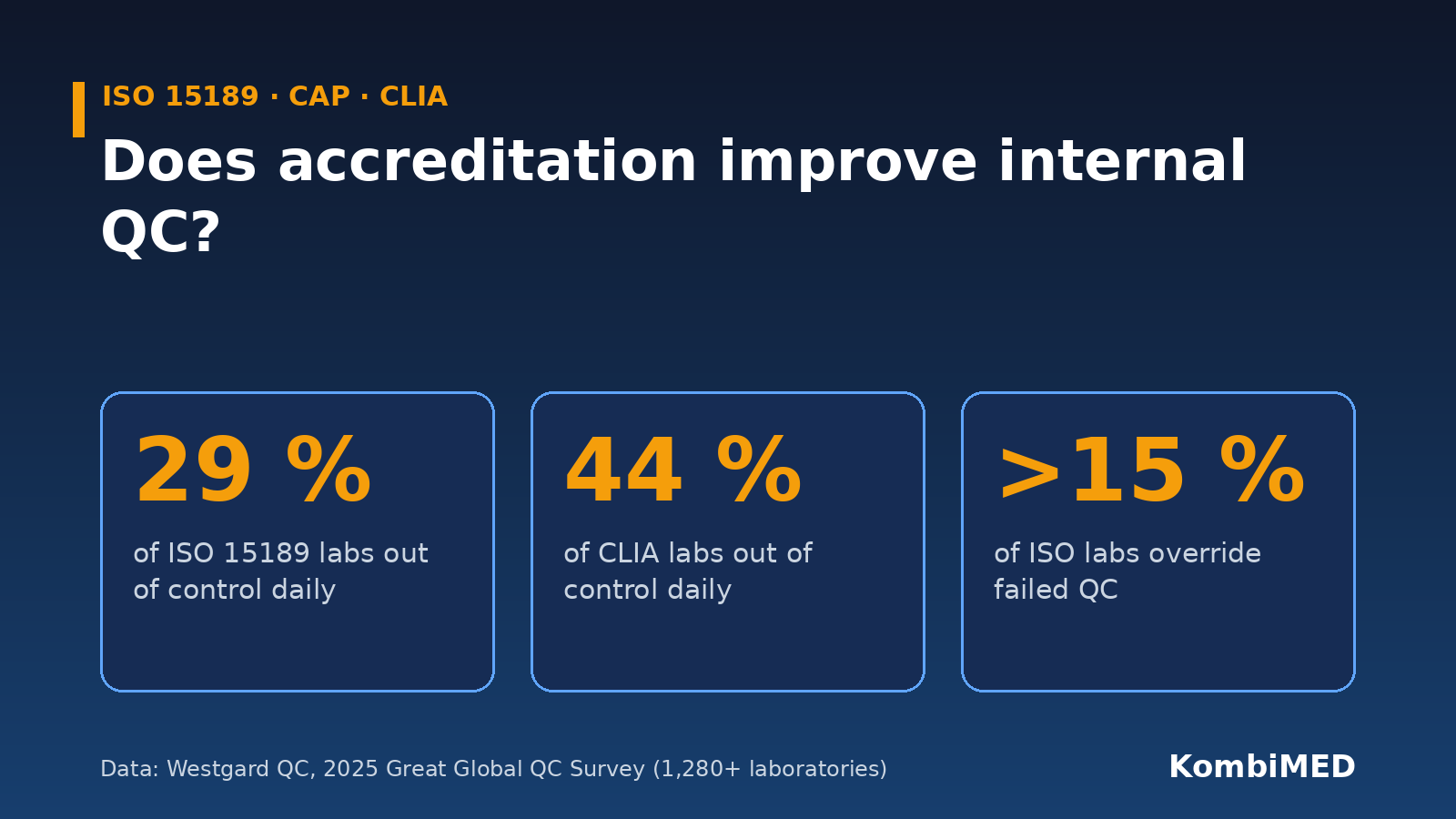
Many laboratories in Central Asia and the Caucasus are preparing for ISO 15189 or CAP accreditation, often expecting that the process itself will raise the quality of their results. The 2025 Great Global QC Survey by Westgard QC allows a reality check: it compares the QC practice of ISO 15189 laboratories with that of US laboratories working under CLIA.
The short answer: accredited laboratories do better on some points — but accreditation does not decide how good internal QC is. The laboratory does.
Three frameworks, one goal
The three frameworks differ in origin and in how they treat QC:
| ISO 15189:2022 | CAP | CLIA | |
|---|---|---|---|
| What it is | International standard for medical laboratories | Accreditation programme of the College of American Pathologists | US federal regulation for clinical laboratories |
| Who assesses | National accreditation bodies | Peer inspectors using CAP checklists | US authorities or approved accreditors |
| Internal QC | QC procedure designed for the intended quality; results reviewed | Detailed checklist requirements per discipline | Defined minimum, e.g. two levels of control per day for most quantitative tests |
| External quality assessment | Required for every examination | CAP proficiency testing; outside the US and Canada at least 6 months before accreditation | Proficiency testing for regulated analytes |
What the survey found
Comparing ISO 15189 laboratories with CLIA laboratories, the survey reports:
- out of control daily or several times a day: 29 % of ISO laboratories vs 44 % of CLIA laboratories;
- Westgard multirules on all tests: 67 % vs 59 %;
- QC frequency: CLIA laboratories mostly run QC once a day — the legal minimum becomes the maximum — while ISO laboratories spread over one, two or three times a day;
- overriding failed QC: more than 15 % of ISO laboratories vs 6 % of CLIA laboratories;
- no measurement uncertainty calculated: 11 % of ISO laboratories vs 34 % of CLIA laboratories — ISO 15189 requires it, CLIA does not.
Why accreditation alone is not enough
Standards require that QC exists, is planned for the intended quality and is reviewed. They do not prescribe which rule to use for which test. The survey author concludes that neither framework gives distinctive, practical guidance on QC design — so two accredited laboratories can run very different QC.
The override figure shows the risk: an accredited laboratory under time pressure may release results from failed runs more often than one under strict minimum rules. Inspectors know this and look at override logs, corrective actions and how QC limits were set.
What to fix before applying
Whether the target is ISO 15189 or CAP, these points are worth reviewing before the self-inspection:
- control limits from your own mean and SD, recalculated at each lot change;
- rules chosen per test, ideally from a sigma metric;
- a written procedure for failed controls: troubleshooting before repeating;
- an override log with reason, person and patient impact;
- measurement uncertainty for every quantitative test;
- an EQA programme for every examination, with documented review of each result.
The regional picture
In the survey, 76 % of responding European laboratories were ISO 15189-accredited and more than 60 % of Asian ones. In the Middle East, CAP was the most common framework (43 %), followed by ISO 15189 (35 %). For laboratories in our region, both routes are open — the choice often depends on clinical-trial ambitions, international patients and what local regulators recognise.
KombiMED is an official CAP distributor and helps laboratories on either route: the free CAP readiness assessment, an overview of the CAP accreditation process and the EQA planning guide.
Frequently asked questions
Does ISO 15189 accreditation improve internal QC?
What is the difference between CAP and ISO 15189?
What should we prepare first for accreditation?
Sources
Survey figures: 2025 Great Global QC Survey: ISO and CLIA labs ↗ — Westgard QC; 2025 Great Global QC Survey: Europe ↗ — Westgard QC; 2025 Great Global QC Survey: Asia ↗ — Westgard QC; 2025 Great Global QC Survey: Middle East ↗ — Westgard QC. Standard: ISO 15189:2022 ↗ — ISO.
Related articles
Quality Control
Quality Control
Quality Control
Planning a purchase in this area?
Tell us what your laboratory needs and we will send you a tailored offer.
Contact KombiMED