
Global QC Survey 2025: Seven Costly QC Habits
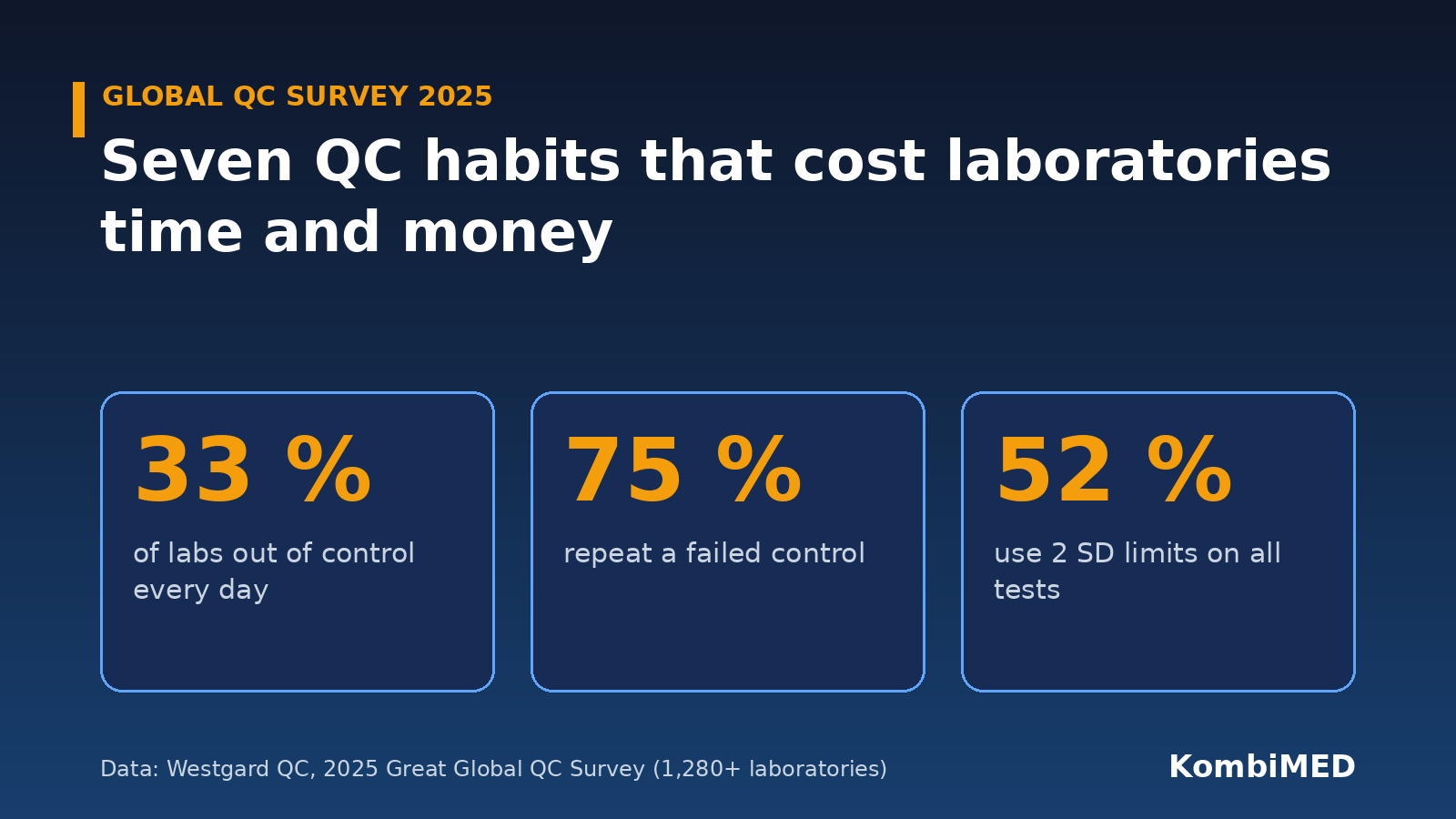
Internal quality control is the most routine task in a medical laboratory — and, according to the largest survey of its kind, one of the least effective. In the 2025 Great Global QC Survey by Westgard QC, one laboratory in three reported being out of control every day or several times a day. Four years earlier it was about one in four.
Most of these alarms are not real analytical errors. They are false rejections produced by control rules that do not fit the method, followed by reactions — repeating the control, overriding the run — that make real errors harder to see. This article summarises what the survey found and how to fix the seven habits behind the numbers.
What is the Great Global QC Survey?
Westgard QC runs the survey every few years and publishes the results free of charge. The 2025 edition (August 2025) collected more than 1,280 responses: 440 from the USA, 289 from Asia, 146 from the Middle East, 143 from Europe, 118 from Africa and 114 from Latin America. The results are compared with the 2021 survey.
Two caveats apply. The laboratories took part voluntarily, so the figures describe the respondents rather than every laboratory in a country. And Central Asia and the Caucasus are not reported separately — the closest reference points are the European and Asian breakouts.
The key figures at a glance
Selected global results, 2021 compared with 2025:
| Indicator | 2021 | 2025 |
|---|---|---|
| Out of control daily or several times a day | ≈ 23 % | 33 % |
| Repeat the control when it fails | 68 % | 75 % |
| 2 SD limits on all tests | 59 % | 52 % |
| Westgard multirules in use | 86 % | 83 % |
| Limits from own mean and SD | 58 % | 70 % |
| Limits from manufacturer ranges | 56 % | 46 % |
| Third-party liquid assayed controls | 43 % | 49 % |
| Release results although QC failed | 10 % | 6.9 % |
| No action at all on QC cost | 64 % | 54 % |
Seven habits — and how to fix them
Each of the following habits is common, understandable and expensive. None of them needs new equipment to fix.
1. 2 SD limits on every test
A ±2 SD limit rejects about 4.5 % of perfectly good runs with one control and about 9 % with two. Applied to every analyte, it guarantees daily false alarms. Half of all laboratories still use it everywhere.
Fix: use 2 SD as a warning at most, and choose rejection rules per test — wider single rules for very good methods, multirules where performance is tight. Our article on why laboratories are "out of control" every day shows the statistics.
2. Repeating the control until it passes
Three quarters of laboratories simply repeat a failed control. If the alarm was false, the repeat usually passes — but if the error was real and small, the repeat can pass too, and the error goes out with the patient results. In Europe, 6.3 % of laboratories even repeat until the value falls inside the limits.
Fix: look at the pattern first (one control or both, one level or all, a trend over several runs) and write down when a repeat is allowed and when troubleshooting is mandatory.
3. Manufacturer ranges instead of your own data
Ranges printed on the package insert are set for many laboratories and many instruments, so they are wide. A shift in your own system can stay inside them for weeks. The good news: 70 % of laboratories now calculate limits from their own mean and SD, up from 58 %.
Fix: establish the mean and SD from your own runs (at least 20 data points per level is the usual starting point) and update them at every lot change.
4. Releasing results although QC failed
Globally 6.9 % of laboratories regularly release patient results from runs that failed QC; in Asia it was 10 %. Every such release is a decision that an auditor will ask about.
Fix: hold results from a failed run until the cause is known, keep an override log with the reason and the person responsible, and re-test patient samples back to the last good run when a real error is confirmed.
5. The same QC for every test
A glucose method with a coefficient of variation of 1 % and an immunoassay with 6 % do not need the same rules or the same number of controls. Treating them alike means too many false alarms on one and too little error detection on the other.
Fix: calculate a sigma metric per test — (allowable total error − bias) ÷ CV — and plan QC from it. High-sigma tests need less QC, low-sigma tests need more.
6. Controls that only mirror the analyser
Manufacturer controls are made for one system and can move together with reagent or calibrator lots, which hides a bias instead of showing it. That is why independent third-party controls are spreading: 49 % of laboratories now use liquid assayed third-party controls, up from 43 %.
Fix: consider independent controls at least for the key analytes. More in third-party vs manufacturer controls.
7. Ignoring what QC costs
More than half of all laboratories have done nothing to manage QC cost. Yet every false rejection costs control material, reagent, technician time and delayed results. Laboratories that act mostly consolidate their controls (20 %) rather than buying cheaper ones (9 %).
Fix: reduce false rejections first — it is the cheapest saving — then consolidate to multi-analyte controls.
What this means for laboratories in Central Asia and the Caucasus
The survey has no separate figures for the region, but the trends from Europe (37 % out of control daily) and Asia (ISO 15189 in more than 60 % of responding laboratories) are the ones laboratories here meet when they prepare for ISO 15189 or CAP accreditation. Inspectors look at how QC is designed and how failures are handled — so a review of the QC plan is a good first step.
KombiMED supports that work from three sides: analysers and control materials from European manufacturers, external quality assessment programmes as the official CAP distributor, and free planning tools in the Laboratory Equipment Consulter — see how well laboratories run internal QC, the CAP readiness assessment and our EQA programmes.
Frequently asked questions
How many laboratories are out of control every day?
Is it wrong to repeat a failed control?
Are the survey results valid for Kazakhstan or Uzbekistan?
Sources
Figures quoted from the Westgard QC survey publications: 2025 Great Global QC Survey Results: the whole world ↗ — Westgard QC; 2025 Great Global QC Survey: Europe ↗ — Westgard QC; 2025 Great Global QC Survey: Asia ↗ — Westgard QC.
Related articles
Quality Control
Quality Control
Quality Control
Planning a purchase in this area?
Tell us what your laboratory needs and we will send you a tailored offer.
Contact KombiMED