
Why Your Lab Is “Out of Control” Every Day
In the 2025 Great Global QC Survey by Westgard QC, 33 % of laboratories reported being out of control every day or several times a day. For very large laboratories the share was 56 %, for small ones 16 %. That sounds like a quality crisis — but most of it is arithmetic.
This article explains where the daily alarms come from, why the usual reaction makes things worse and how to choose control rules that catch real errors without stopping the analyser for nothing.
How often should a stable method fail QC?
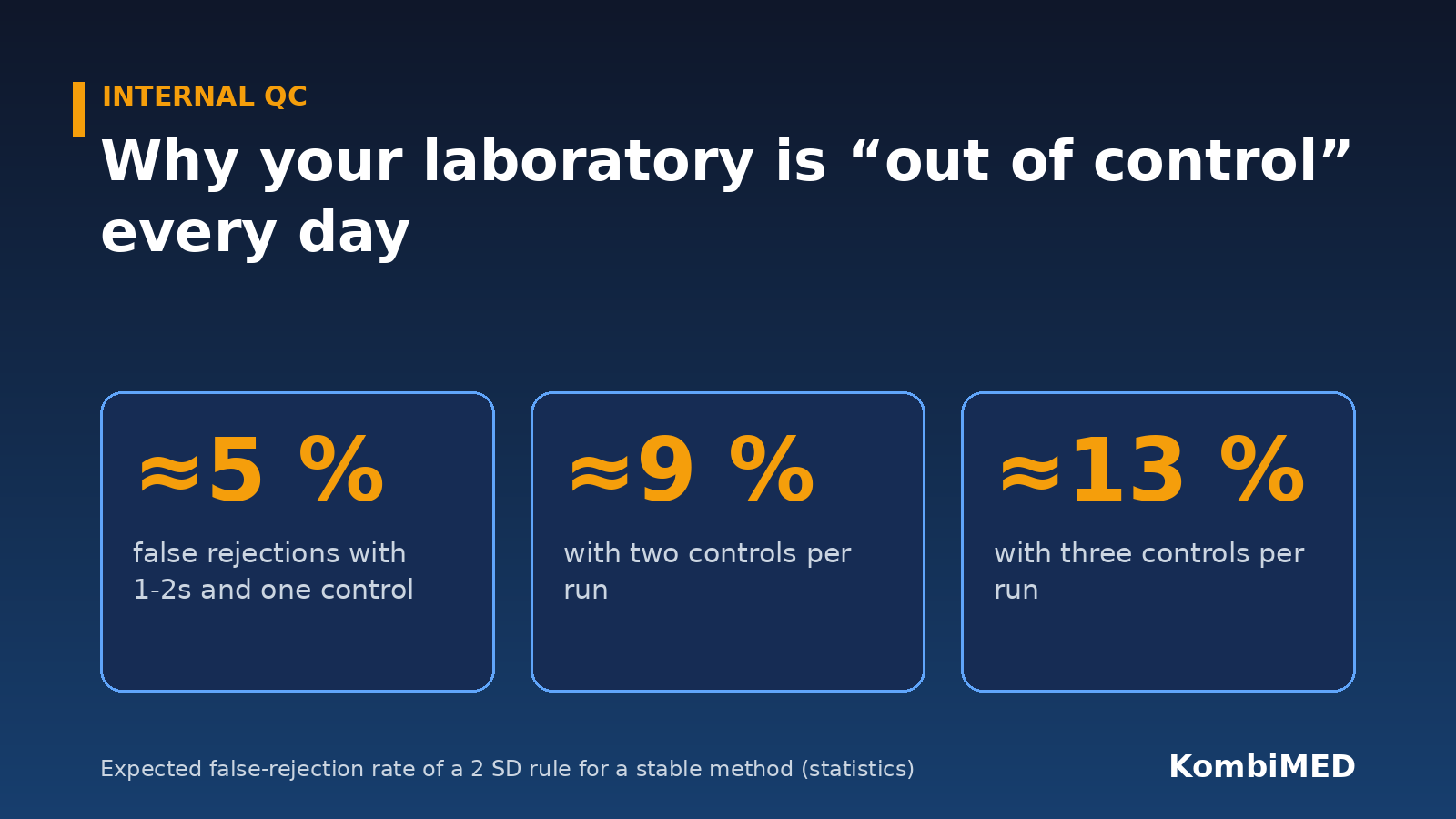
With a ±2 SD limit (the 1-2s rule), a control from a perfectly stable method falls outside the limits about 4.5 % of the time — that is simply how the normal distribution works. Every additional control in a run adds another chance of a false alarm:
| Controls per run (1-2s rule) | Expected false rejections |
|---|---|
| 1 | ≈ 4.5 % |
| 2 | ≈ 9 % |
| 3 | ≈ 13 % |
Why a busy laboratory is always "out of control"
Now multiply by the test menu. A laboratory that runs 20 analytes with two controls each, once a day, will see at least one false alarm on about 85 % of days — even if every method is working perfectly. Larger laboratories run more analytes and more runs, so they see more alarms. That is why 56 % of very large laboratories in the survey report daily out-of-control events, against 16 % of small ones.
The survey shows that the habit is persistent: 52 % of laboratories still use 2 SD limits on all tests, and 80 % use them on at least some.
Why repeating the control is a trap
When the alarm comes every day, staff learn that it is usually false — and simply repeat the control. Three quarters of laboratories do exactly that. The problem: when the error is real but small, the repeat often lands inside the limits as well. The run is accepted, the shifted results go to the clinician, and the cause is never looked for.
Over-sensitive rules therefore do not make QC stricter. They train people to ignore it.
Multirules instead of a single 2 SD limit
The Westgard multirules combine several criteria so that false alarms stay rare while real errors are still caught. The most common ones:
- 1-3s — one control beyond ±3 SD: random error or a large systematic error;
- 2-2s — two consecutive controls beyond the same 2 SD limit: systematic error;
- R-4s — two controls in one run more than 4 SD apart: random error;
- 4-1s — four consecutive controls beyond the same 1 SD limit: small systematic shift;
- 10x — ten consecutive controls on the same side of the mean: trend or bias.
Choosing rules by sigma metric
Not every test needs the full set. The sigma metric shows how much room a method has: Sigma = (allowable total error − |bias|) ÷ CV, all in percent. Example: allowable error 10 %, bias 1 %, CV 1.5 % gives 6 sigma; the same test with a CV of 3 % gives 3 sigma.
As a rule of thumb, the higher the sigma, the simpler the QC can be:
| Sigma | Typical QC approach |
|---|---|
| ≥ 6 | One wide rule (1-3s), two controls per run — false alarms become rare |
| 5 | 1-3s / 2-2s / R-4s with two controls |
| 4 | Add 4-1s; four control results per run or two runs a day |
| < 4 | Full multirule, more controls and more frequent runs — and work on the method itself |
What a laboratory can do this month
Most of the improvement costs nothing but time:
- list every analyte with its CV (from your own QC data), bias (from EQA) and allowable error;
- calculate the sigma metric and group the tests;
- replace blanket 2 SD rejection with rules per group;
- write down when a repeat is allowed and when troubleshooting comes first;
- track the number of rejections per month — it should fall, while EQA results stay good.
Where software and equipment help
QC software calculates sigma metrics, applies multirules automatically and blocks runs that fail them — see our overview of quality control software. When analysers are replaced, imprecision and bias decide how much QC the new system will need; KombiMED takes this into account when comparing instruments, and the Laboratory Equipment Consulter explains how internal QC and external quality assessment fit together.
Frequently asked questions
Why does a 2 SD rule cause so many false alarms?
What is a sigma metric?
Should we stop using Westgard rules?
Sources
Survey figures: 2025 Great Global QC Survey Results: the whole world ↗ — Westgard QC; 2025 Great Global QC Survey: Labs big and small ↗ — Westgard QC. False-rejection rates are the expected values of the normal distribution for a stable method.
Related articles
Quality Control
Quality Control
AI & Software
Planning a purchase in this area?
Tell us what your laboratory needs and we will send you a tailored offer.
Contact KombiMED