
Third-Party vs Manufacturer Controls in Lab QC
Which control material a laboratory uses decides what its internal QC can actually see. The 2025 Great Global QC Survey by Westgard QC shows a clear shift: independent third-party controls are gaining ground, manufacturer controls are losing it. Here is what drives the change and what to consider before switching.
Two kinds of control material
Manufacturer controls are made by the producer of the analyser or reagent and come with target values for that system. They are convenient and well matched to the method.
Third-party controls come from an independent producer. They are not tied to one reagent or calibrator lot, usually cover many analytes in one material and can be used on different platforms; many come with peer-group programmes that compare your values with other laboratories using the same method.
What the survey shows
Globally, compared with 2021:
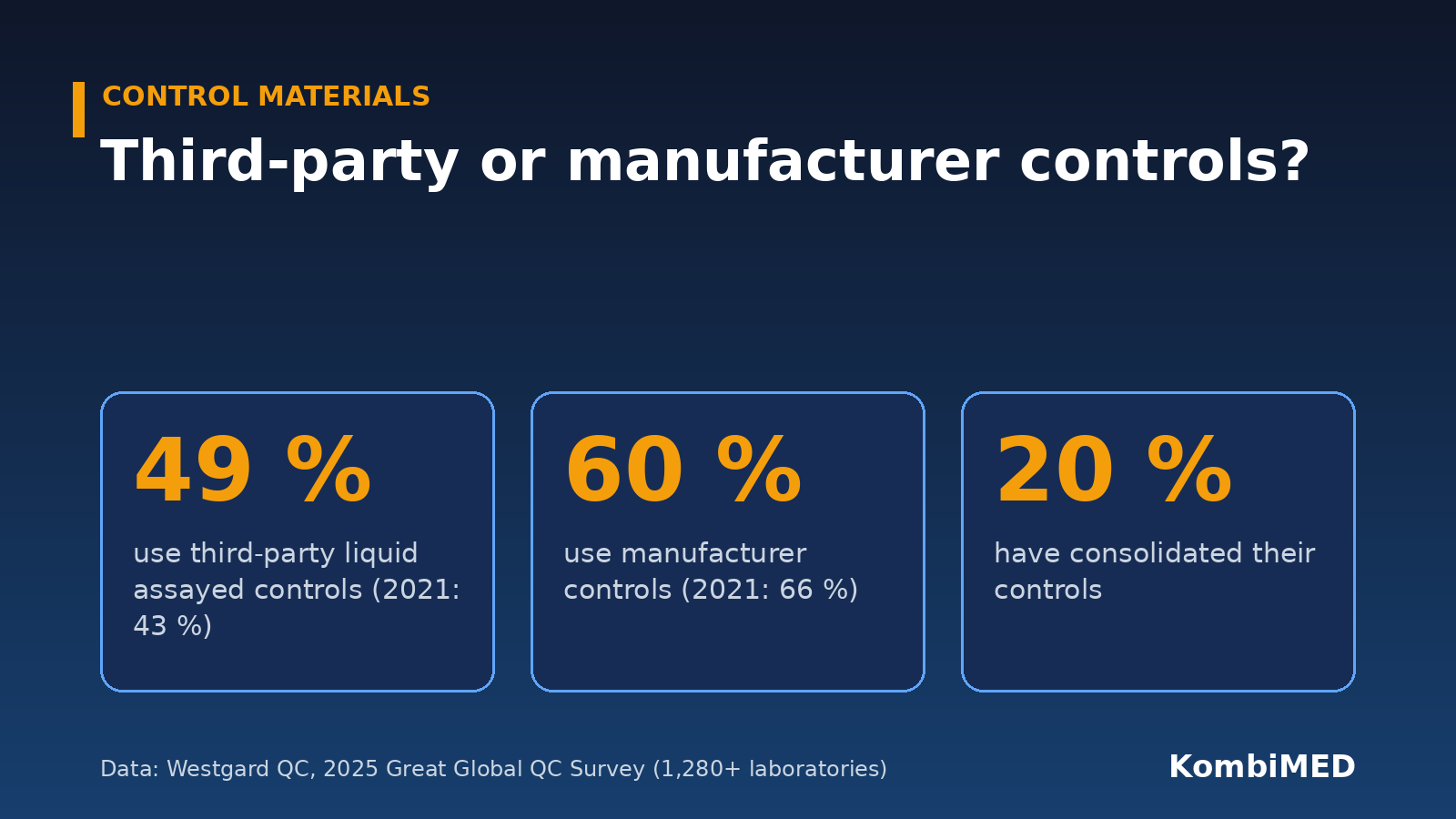
- third-party liquid assayed controls: 43 % → 49 %;
- third-party unassayed controls: 20 % → 25 %;
- manufacturer controls: 66 % → 60 %;
- Asia: third-party lyophilised controls 35 % → 52 %, manufacturer controls 66 % → 51 %;
- Europe: third-party liquid controls 50 %, manufacturer controls 65 %;
- Middle East — the exception: manufacturer controls rose to more than 72 %.
Why independence matters
A control made for one system can move together with that system. When a new reagent or calibrator lot shifts results, a matched control may shift with it — the run passes and the bias goes unnoticed. An independent control does not share that dependency and shows the shift.
ISO 15189 therefore advises laboratories to consider independent third-party control material, either instead of or in addition to the manufacturer's controls.
Advantages and limits
Neither option is right for every test:
| Manufacturer controls | Third-party controls | |
|---|---|---|
| Detects lot-related bias | Limited | Yes |
| Fit to the method | Very good | Good; check commutability for some analytes |
| Analytes per material | Often few | Often many (consolidation possible) |
| Use across analysers | Usually one system | Several platforms |
| Peer comparison | Sometimes | Common (peer-group programmes) |
| Price per vial | Often included or low | Higher, but fewer materials needed |
Consolidation and the cost of QC
More than half of the laboratories in the survey (54 %) had taken no action on QC cost. Of those that did, 20 % consolidated their controls — fewer, multi-analyte materials, fewer open vials and less waste — while only 9 % switched to cheaper controls. Consolidation usually saves more than a lower price per vial, because it also reduces handling time and the number of lots to validate.
How to switch without losing control
A change of control material is a change in the QC system and should be planned like one:
- run the new control in parallel with the old one for at least 20 runs per level;
- set your own mean and SD from those runs instead of using the package-insert range;
- check open-vial stability and storage against your workload;
- confirm that the material behaves like patient samples for critical analytes;
- join the peer-group programme and keep EQA unchanged during the transition.
Control materials through KombiMED
KombiMED procures control materials together with analysers and reagents, so that the QC concept is part of the equipment decision rather than an afterthought — see reagents and consumables. For the external side, we provide EQA programmes including CAP proficiency testing as an official distributor. Background on choosing rules: why laboratories are "out of control" every day.
Frequently asked questions
What are third-party controls?
Are third-party controls more expensive?
Should we replace manufacturer controls completely?
Sources
Survey figures: 2025 Great Global QC Survey Results: the whole world ↗ — Westgard QC; 2025 Great Global QC Survey: Asia ↗ — Westgard QC; 2025 Great Global QC Survey: Europe ↗ — Westgard QC; 2025 Great Global QC Survey: Middle East ↗ — Westgard QC.
Related articles
Quality Control
Quality Control
Quality Control
Planning a purchase in this area?
Tell us what your laboratory needs and we will send you a tailored offer.
Contact KombiMED