
External Quality Assessment for Point-of-Care Testing (POCT)
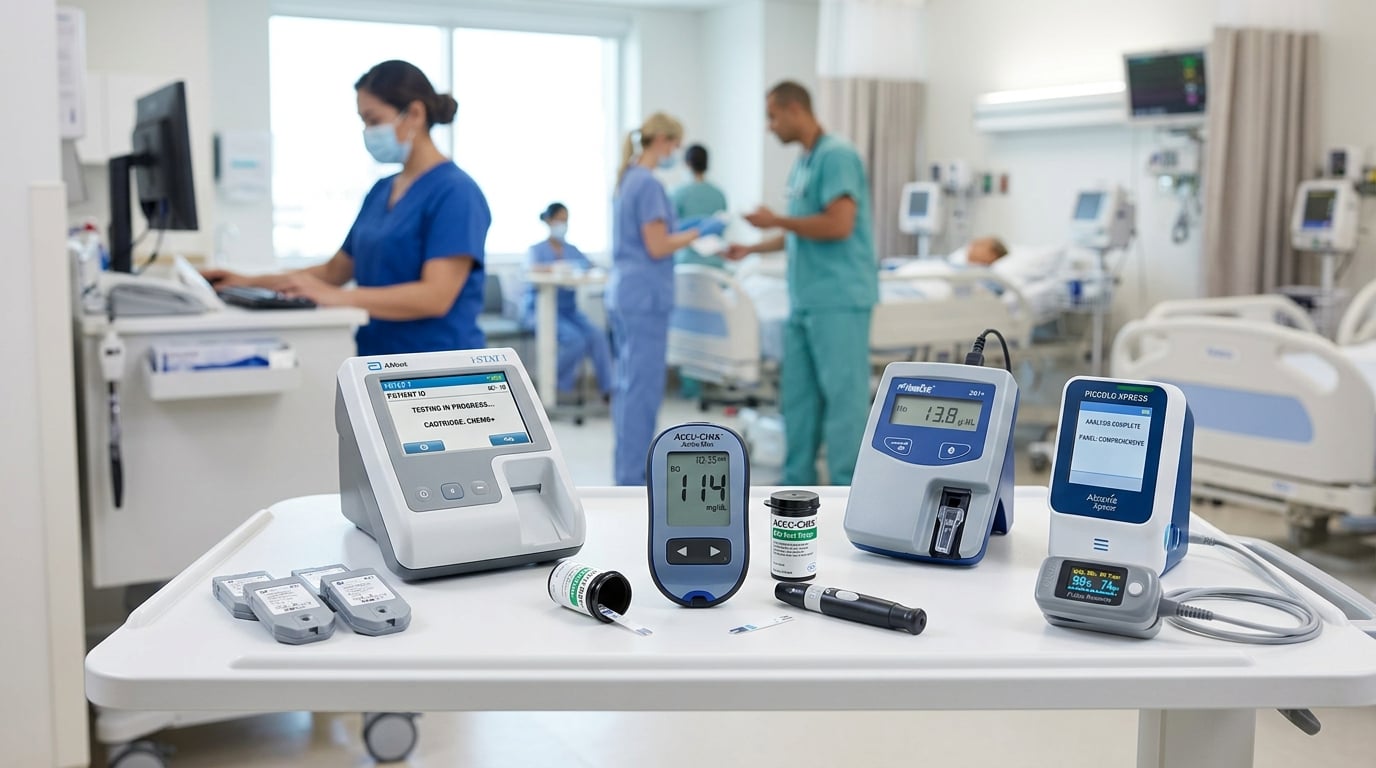
External quality assessment (EQA) for Point-of-Care Testing (POCT) is an independent evaluation of the accuracy of results obtained on portable analyzers outside the central laboratory. GOST R ISO 15189-2024 (the Russian national adoption of ISO 15189) brought POCT into the scope of laboratory quality management for the first time, which makes participation in proficiency testing (PT) programs mandatory for all institutions that use rapid diagnostics.
POCT: A Special Challenge for Quality Control
Point-of-care tests are performed in emergency departments, intensive care units, operating rooms and ambulances, wherever the speed of obtaining a result is critical. Portable analyzers deliver results within minutes, but the operator may be a physician or a nurse rather than a laboratory technician.
Risk factors for POCT quality:
That is why external quality assessment for POCT is not an option but a necessity.
- Testing is performed by non-laboratory staff, so pre-analytical errors are more likely
- Operating conditions are far from ideal: temperature, humidity, vibration
- Limited internal quality control: not all POCT devices support full IQC
- Many testing sites make it difficult to ensure consistent results
- No integration with the LIS creates a risk of data loss and makes retrospective analysis impossible
Types of POCT Subject to EQA
Emergency Clinical Chemistry
- Blood gases: pH, pO₂, pCO₂, HCO₃⁻, BE
- Electrolytes: Na⁺, K⁺, Ca²⁺ (ionized), Cl⁻
- Metabolites: glucose, lactate, creatinine
- Bilirubin: neonatal screening
Cardiac Markers for Emergency Diagnosis
- Troponin (hs-cTnI / cTnI): rapid diagnosis of myocardial infarction
- NT-proBNP / BNP: rapid assessment of heart failure
- D-dimer: rapid rule-out of pulmonary embolism (PE)
Bedside Coagulation Testing
- INR: portable coagulometers for monitoring warfarin therapy
- ACT (activated clotting time): heparin monitoring in the operating room
Urinalysis
- Test strips: pH, protein, glucose, ketones, leukocytes, nitrites, blood
- Automated urine analyzers (semi-quantitative and microscopic analysis)
Other POCT Areas
- HbA1c: POCT measurement for immediate adjustment of diabetes therapy
- ESR: rapid methods
- Blood glucose monitoring: high-volume POCT with special control requirements in hospitals
EQA Programs for POCT
| Provider | Program | Frequency | Area |
|---|---|---|---|
| CAP | POCT Proficiency Testing | 3×/year | Blood gases, electrolytes, glucose, cardiac markers |
| CAP | UA — Urinalysis | 3×/year | Urinalysis (chemistry and sediment) |
| Randox RIQAS | POCT / Blood Gas | 12×/year | Blood gases, electrolytes, metabolites |
| Randox RIQAS | Urinalysis | 12×/year | Urinalysis |
| Bio-Rad EQAS | Blood Gas | 12×/year | Blood gases and electrolytes |
| Bio-Rad EQAS | Urinalysis | 12×/year | Urinalysis |
| INSTAND e.V. | POCT, Blood Gas | 2–4×/year | Rapid diagnostics |
| Labquality | POCT | 4–6×/year | Full range of POCT tests |
Compatibility with POCT Equipment
| Device | Manufacturer | Test type | Recommended EQA |
|---|---|---|---|
| i-STAT Alinity | Abbott | Blood gases, electrolytes, troponin, INR | CAP POCT, RIQAS, INSTAND |
| cobas b 123 | Roche | Blood gases, electrolytes, metabolites | CAP, RIQAS, Bio-Rad |
| cobas h 232 | Roche | Cardiac markers (troponin, NT-proBNP, D-dimer) | CAP, RIQAS, INSTAND |
| CoaguChek XS / INRange | Roche | INR | CAP POCT, RIQAS, INSTAND |
| GEM Premier 5000 | Werfen | Blood gases, electrolytes, metabolites | CAP, RIQAS, Bio-Rad |
| UC-3500 / UC-1000 | Sysmex | Automated urinalysis | CAP UA, RIQAS, Bio-Rad |
| Glucose meters (Accu-Chek, OneTouch) | Various | Capillary blood glucose | CAP, RIQAS, Labquality |
New GOST R ISO 15189-2024 Requirements for POCT
The key innovation of the standard is the explicit inclusion of POCT in the laboratory's quality management system. This means:
1. The laboratory is responsible for the quality of POCT performed in clinical departments
2. Mandatory participation in EQA programs for every type of POCT device and every parameter
3. Operator training and competence: documented qualification of non-laboratory staff
4. Integration of POCT data into the LIS to ensure traceability of results
5. Regular verification: comparison of POCT device results with the central laboratory
Practical Recommendations
Organizing EQA for POCT
- Centralize management: appoint a POCT coordinator in the central laboratory
- Register each device separately in the EQA program and compare instrument with instrument
- Run comparisons with the central laboratory at least once a quarter; this supplements EQA and does not replace it
Choosing a Program
- For emergency laboratories with i-STAT / cobas b: CAP POCT + RIQAS Blood Gas is the optimal combination
- For cardiology departments with cobas h 232: a separate cardiac marker program
- For ward glucose meters: mandatory participation in a dedicated program (CAP Glucose Monitoring)
Staff Training
- Develop standard operating procedures (SOPs) for each type of POCT device
- Recertify POCT operators annually
- Use EQA results as a training tool by reviewing errors with clinical staff
Documentation
- Keep a register of all POCT devices linked to their EQA programs
- Archive EQA results and corrective actions, as required by ISO 15189
- Ensure traceability from each EQA result to the specific device and operator
KombiMED's Comprehensive Approach
KombiMED supplies POCT equipment for emergency diagnostics, cardiology, urinalysis and anticoagulant therapy monitoring. We provide the full cycle, from device delivery to enrollment in international EQA programs and development of SOPs for clinical staff.
Our specialists will help you:
Request a consultation on external quality assessment for point-of-care testing.
- Select EQA programs for each type of POCT device in your institution
- Develop a POCT quality management system in line with GOST R ISO 15189-2024
- Organize training and certification of non-laboratory staff
Related articles
Quality Control
Quality Control
Quality Control
Planning a purchase in this area?
Tell us what your laboratory needs and we will send you a tailored offer.
Contact KombiMED