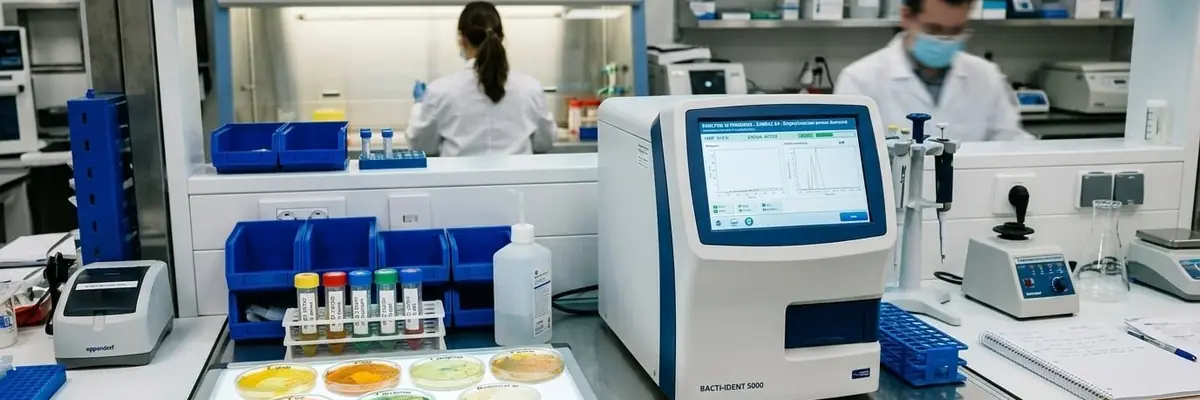
Every discipline fails in its own way, and EQA programmes are built around those failure modes. This page goes through the disciplines of a medical laboratory one by one: what the programmes cover, which providers run them, how often samples arrive, and what to check when choosing.
Frequencies are distributions per year in typical schemes, not a fixed offer; the exact programme list depends on the test menu and the analysers. Provider profiles are on EQA providers compared.
Enzymes, substrates, lipids, electrolytes, HbA1c and specific proteins — the bulk of a laboratory’s daily volume, so an undetected bias reaches the most patients. Programmes run from quarterly schemes to monthly or bi-weekly distributions that show shifts quickly.
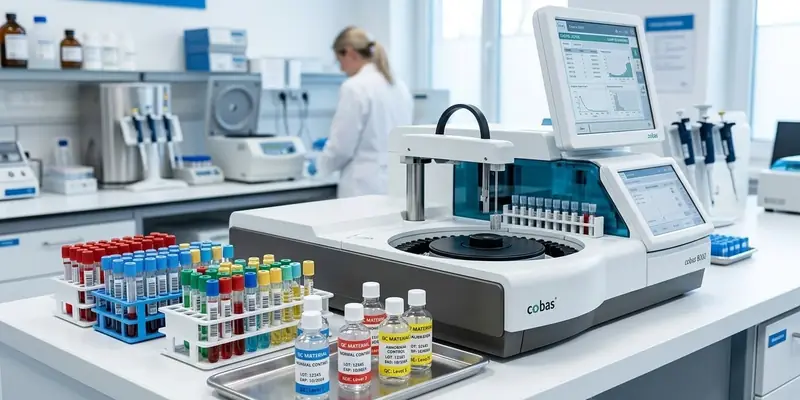
| Typical analytes | AST, ALT, GGT, ALP, LDH, CK, glucose, urea, creatinine, total protein, albumin, bilirubin, cholesterol, HDL, LDL, triglycerides, Na, K, Cl, Ca, Mg, P, Fe, HbA1c, CRP |
|---|---|
| Programmes | CAP chemistry and HbA1c surveys 3–4× · Randox RIQAS up to 24× · Bio-Rad EQAS 12× · INSTAND 2–4× · Labquality 4–6× |
| Peer grouping | By method and analyser; check that a peer group exists for your platform before enrolling |
| Watch out for | Reconstitution errors with lyophilised samples, unit and transcription errors, creatinine and enzyme methods that differ between platforms |
More: External quality assessment in clinical chemistry
The full blood count with differential, reticulocytes and extended parameters, plus morphology. Without external control, a systematic haemoglobin bias misclassifies anaemia, wrong platelet counts distort the assessment of haemostasis, and a faulty differential can miss blast cells.
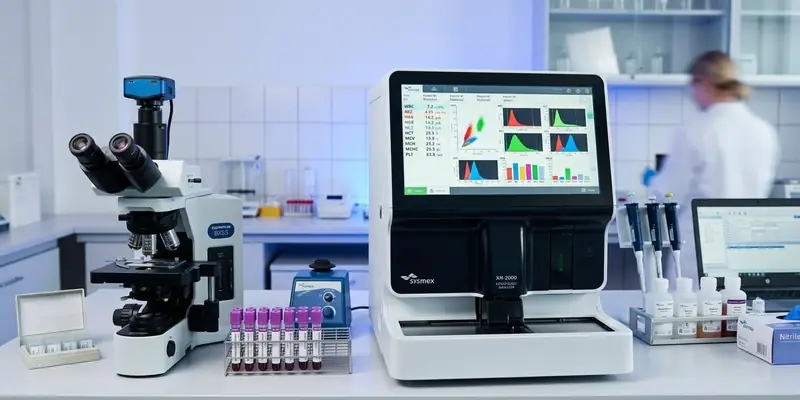
| Typical parameters | RBC, Hb, Hct, MCV, MCH, MCHC, RDW, WBC, 5-part differential, PLT, MPV, reticulocytes, NRBC, IG, ESR |
|---|---|
| Programmes | CAP haematology surveys 3–4× · Randox RIQAS 12× · UK NEQAS 6× · INSTAND 4×; separate morphology panels test the microscopists |
| Sample format | Stabilised blood; short shelf life, so transport time and temperature matter |
| Watch out for | Systematic shifts in one direction over several rounds; compare them with the Levey-Jennings charts of internal QC |
More: External quality assessment in haematology · Haematology analysers
Screening tests, special tests and anticoagulant monitoring. The INR is a calculated value that depends on the ISI of the thromboplastin, the calibration of the specific instrument with the specific reagent lot and the endpoint method, so a comparison is only valid within the same instrument and reagent combination.
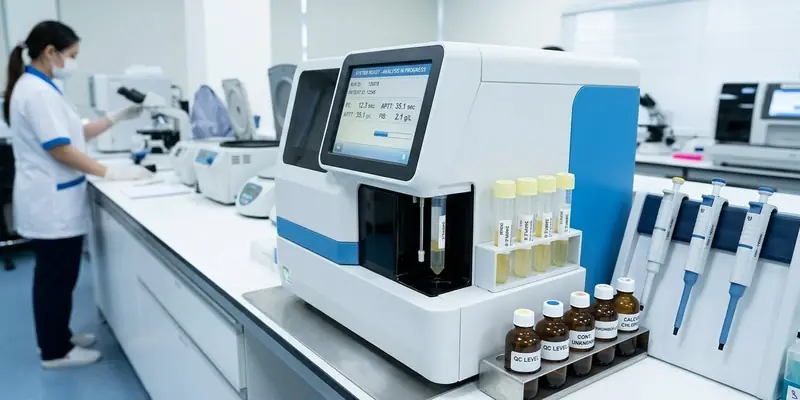
| Typical parameters | PT/INR, APTT, fibrinogen, D-dimer, antithrombin, protein C and S, factor assays, lupus anticoagulant, anti-Xa |
|---|---|
| Programmes | CAP · Randox RIQAS · Bio-Rad EQAS · UK NEQAS · INSTAND |
| Peer grouping | By instrument and reagent system — essential for PT/INR |
| Sample format | Lyophilised plasma for most schemes; frozen liquid plasma is closer to native samples but needs a strict cold chain |
| Watch out for | Clinical acceptability (is the INR in the right therapeutic band?) besides analytical accuracy; growing demand for anti-Xa and DOAC monitoring |
More: External quality assessment in coagulation
Cardiac markers, hormones, tumour markers, therapeutic drug monitoring, autoimmune and allergy testing. It is the most method-dependent area of the laboratory: results for one analyte differ between platforms, so an all-method comparison says little and peer grouping by method and analyser is essential.
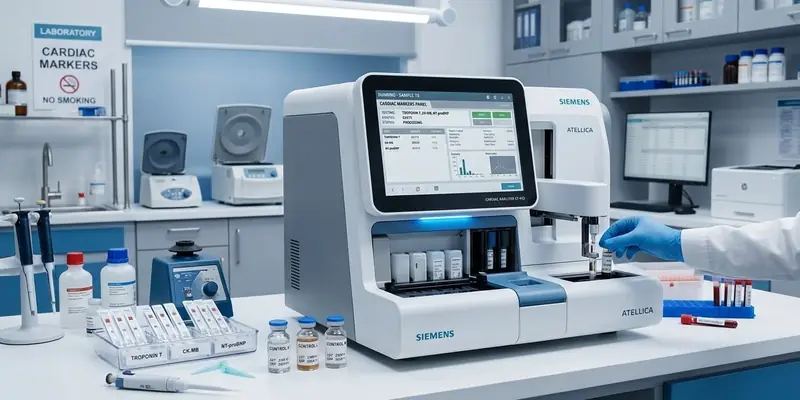
| Typical analytes | hs-cTnI/T, NT-proBNP, CK-MB, D-dimer; TSH, fT4, FSH, cortisol, vitamin D; PSA, CA 125, CA 19-9, CEA, AFP; TDM, autoantibodies, allergen-specific IgE |
|---|---|
| Programmes | CAP (including accuracy-based surveys) · Randox RIQAS (incl. Cardiac) · Bio-Rad EQAS · UK NEQAS · INSTAND |
| Sample format | Prefer commutable material; accuracy-based panels assess trueness, not only agreement with peers |
| Watch out for | An hs-troponin bias near the decision limit can mean a missed myocardial infarction — monthly schemes find such shifts early |
More: External quality assessment in immunochemistry and cardiac markers · Immunochemistry analysers
Identification and antimicrobial susceptibility testing, mycology, blood cultures, parasitology and infection serology. Because antimicrobial resistance is among the leading threats to public health, correct identification and susceptibility results are a public-health matter as much as a laboratory one.
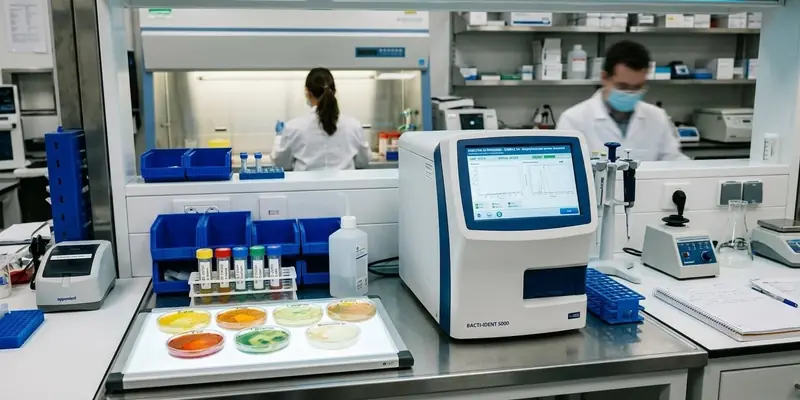
| Scope | Bacterial identification (incl. MALDI-TOF), AST with MIC, MRSA, ESBL and carbapenemases, yeasts and moulds, blood cultures, AFB, parasites, serology |
|---|---|
| Programmes | CAP · UK NEQAS (bacteriology, AST) · INSTAND · Labquality; QCMD for molecular pathogen detection |
| Assessment | Identification to species level, S/I/R categories and MIC values against the reference, turnaround time |
| Sample format | Lyophilised strains, simulated clinical specimens, digital panels for microscopy (Gram stain, colony morphology) |
More: External quality assessment in microbiology · Microbiology equipment
The whole analytical chain, because each step can fail on its own: nucleic acid extraction, amplification, detection (Ct values or dPCR copy numbers), sequencing, bioinformatics and the clinical report. A scheme that only checks the final call misses where the error happened.
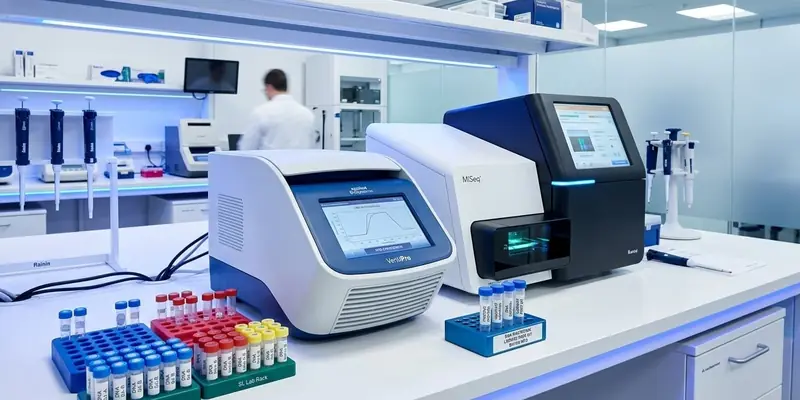
| Typical targets | HIV, HCV and HBV viral loads, HPV genotyping, respiratory panels, TB/MTB, SARS-CoV-2, STI panels; in genetics and oncology BRCA, CFTR, AML and NGS panels |
|---|---|
| Programmes | QCMD (2–4×) · CAP (incl. NGS) · INSTAND · EMQN and GenQA for molecular genetics |
| Sample format | Lyophilised panels, plasma spiked with viral particles for quantitative tests, reference DNA with validated variants for NGS |
| Watch out for | Cold-chain logistics for some panels; the bioinformatics pipeline needs its own validation and EQA coverage |
More: External quality assessment in molecular diagnostics · Real-time PCR · Digital PCR
The quality of tissue preparations, immunohistochemical and in-situ hybridisation staining, and morphological interpretation. Up to 20 % discordance in HER2 status has been described between laboratories without EQA — and HER2 status decides whether a targeted therapy is prescribed.
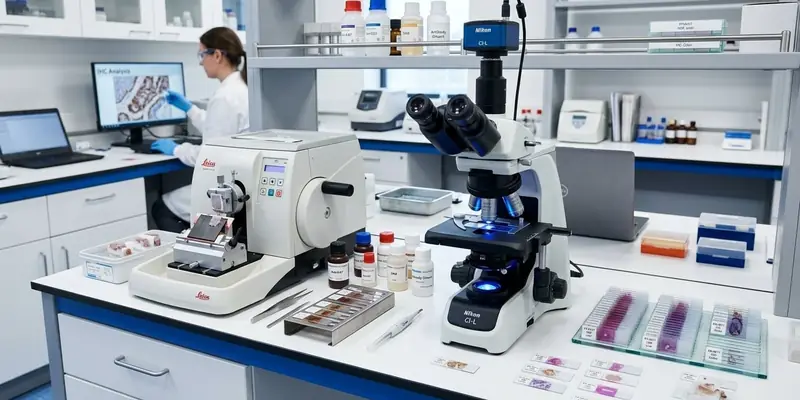
| Typical markers | ER, PR, HER2 (IHC and ISH), Ki-67, PD-L1, cytokeratin panels, TTF-1, p53 |
|---|---|
| Programmes | NordiQC (2–3 runs per module) · CAP · UK NEQAS (immunocytochemistry) · ESP for morphology |
| Assessment | Sensitivity, specificity, background, adequacy of controls and staining intensity; NordiQC grades protocols as optimal, good, borderline or poor |
| Watch out for | Pre-analytics: fixation time and processing decide staining quality before the stainer runs |
More: External quality assessment in histopathology and IHC · Histology equipment · Staining systems
Every POCT examination. Since ISO 15189:2022 includes the former ISO 22870 requirements, POCT run under the laboratory’s governance belongs to its quality management, including EQA, operator training and data traceability; identical devices are kept comparable with each other. POCT devices are run by non-laboratory staff, often without LIS connection — exactly where errors go unseen.
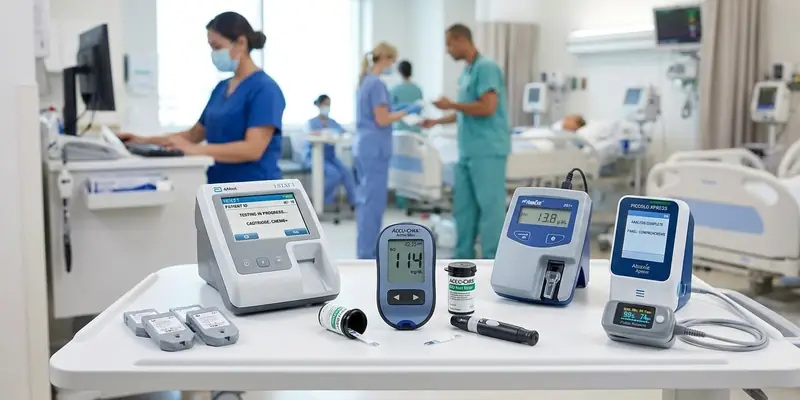
| Typical tests | Glucose meters, blood gases and electrolytes, lactate, cardiac troponin, HbA1c, coagulation (INR), urine dipsticks, rapid tests |
|---|---|
| Programmes | CAP · Randox RIQAS (incl. blood gas) · Bio-Rad EQAS · INSTAND · Labquality |
| Organisation | A POCT coordinator in the central laboratory; each device registered separately; comparisons with the central laboratory at least quarterly, in addition to EQA |
More: External quality assessment for point-of-care testing · POCT analysers
Urine chemistry with test strips or automated readers and urine particle analysis. The programmes come from the same core providers as clinical chemistry, so they are usually added to an existing subscription rather than bought separately.
| Typical parameters | Dipstick chemistry (protein, glucose, ketones, blood, leukocytes, nitrite), urine sediment and particle counts, urine albumin and creatinine |
|---|---|
| Programmes | CAP · Randox RIQAS · Bio-Rad EQAS |
Food, water, environmental and pharmaceutical quality-control laboratories are accredited to ISO/IEC 17025:2017 and need proficiency testing too. Typical scopes are pathogens such as Salmonella, Listeria and E. coli, pesticide residues, mycotoxins, heavy metals, allergens, GMO and veterinary drug residues. Which schemes fit depends on the matrix and the method; the investment memorandum maps them for the specific test menu.
No provider is the best choice everywhere. The mapping below follows the “core plus specialisation” principle described on EQA providers compared:
| Discipline | Primary | Additional |
|---|---|---|
| Clinical chemistry | CAP, RIQAS | Bio-Rad, INSTAND, RfB |
| Haematology | CAP, RIQAS | Bio-Rad, UK NEQAS, INSTAND |
| Coagulation | CAP, RIQAS | Bio-Rad, UK NEQAS |
| Immunochemistry | CAP, RIQAS | Bio-Rad, INSTAND, UK NEQAS |
| Microbiology | CAP, UK NEQAS | INSTAND, Labquality |
| Molecular diagnostics | QCMD, CAP | INSTAND, EMQN |
| Histopathology / IHC | NordiQC, CAP | UK NEQAS, ESP |
| POCT | CAP, RIQAS | INSTAND, Labquality |
| Urinalysis | CAP, RIQAS | Bio-Rad |
